
This article is for educational purposes and is not a substitute for professional medical advice, diagnosis, or treatment. Always seek the advice of your physician or another qualified health provider with any questions you have regarding a medical condition.
Common Signs of a Nutrient Deficiency: Listening to Your Body
Nutrient deficiencies often develop slowly and their signals are subtle at first. You might feel a little more tired than usual or notice your hair isn’t as full as it once was. These small changes are sometimes your body’s way of communicating a need for more support. The body is intelligent and prioritizes sending nutrients to vital organs like the heart and brain. This means the first visible signs of a nutritional gap frequently appear in your hair, skin, and nails.
This is where the concept of a subclinical deficiency becomes important. It describes a state where your nutrient levels are low enough to cause symptoms but not yet low enough to be flagged as a critical deficiency on a standard blood test. Observing these physical signals is not about judgment. It is about listening to your body with curiosity and compassion to understand what it needs to function at its best.
Why Nutrient Gaps Happen Even on a “Healthy” Diet
You might follow a balanced eating pattern and still experience nutritional shortfalls. Several factors contribute to this. Modern farming practices sometimes lead to soil depletion, which means the fruits and vegetables grown in it have fewer minerals than they did decades ago. The long-term storage and transportation of food also affects its nutrient content. Beyond the food itself, individual differences in absorption play a huge role. Your unique genetics, gut health, and stress levels all influence how well your body breaks down and uses the nutrients you consume.
Life stages also change your body’s demands. Pregnancy, periods of rapid growth, and aging all increase the need for specific vitamins and minerals. Chronic stress further increases the body’s use of nutrients like magnesium and B vitamins, making it harder to keep your levels in an optimal range.
The Role of Micronutrients in Daily Function
Micronutrients are the vitamins and minerals your body needs in small amounts to carry out essential functions. Think of them as the spark plugs for your cellular engines. They activate the enzymes that power everything from energy production to immune defence. This is why eating a variety of colourful foods is so helpful. Each colour in a fruit or vegetable often corresponds to different vitamins and antioxidants, so a diverse plate supports a broad nutrient profile.
Vitamins are typically grouped into two categories. Water-soluble vitamins, like Vitamin C and the B vitamins, are not stored in the body for long and need to be replenished regularly. Fat-soluble vitamins, such as vitamins A, D, E, and K, are stored in your body’s fatty tissues and liver, so consistent intake is important for maintaining adequate levels.
The Nutrient Deficiency Checklist: Physical Signs to Watch For
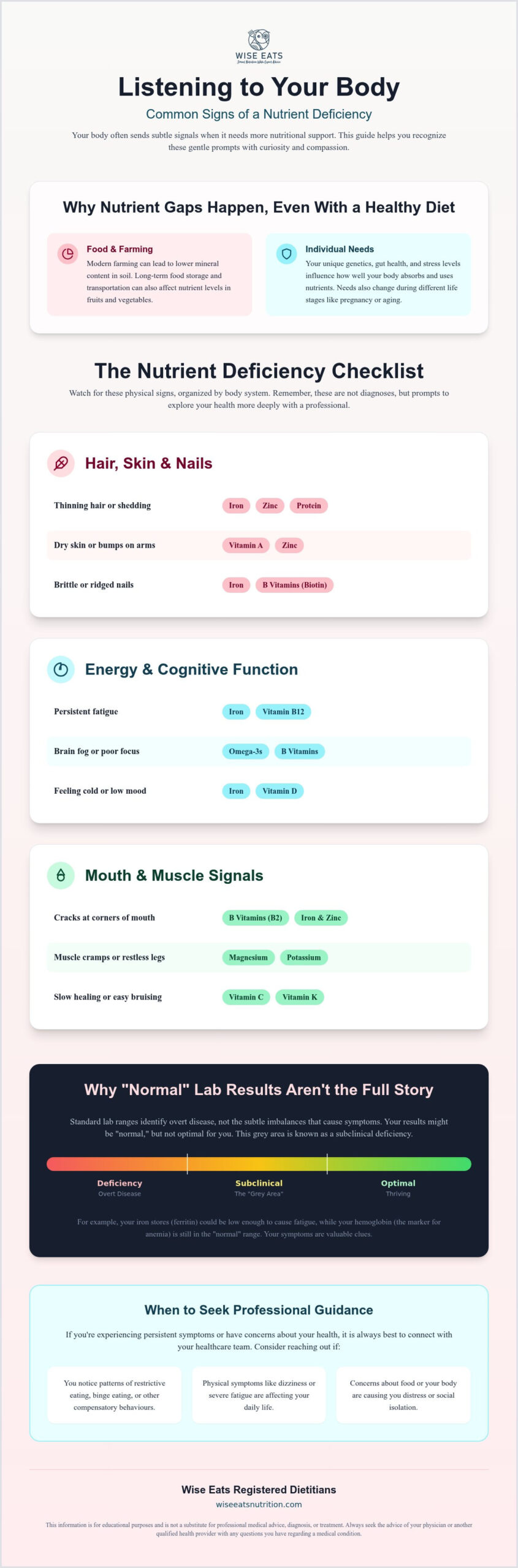
This checklist is organized by body system to help you scan for patterns. These signs are not definitive diagnoses, as many have non-nutritional causes. Instead, view them as gentle prompts to explore your health more deeply with a qualified professional. For example, brittle nails are sometimes related to inadequate protein or low iron intake, but they are also associated with other factors.
Hair, Skin, and Nail Changes
- Thinning hair or excessive shedding: A potential link exists between hair loss and low levels of iron, zinc, or inadequate protein.
- Dry, scaly skin or bumps on the back of arms: These skin changes are sometimes associated with low levels of Vitamin A or zinc. The small, rough bumps are known as keratosis pilaris.
- Brittle, spoon-shaped, or ridged nails: Nails that break easily or have an unusual shape or texture could point toward gaps in iron or B vitamins, particularly biotin.
Energy Levels and Cognitive Function
- Persistent fatigue: Feeling tired even after a full night’s sleep is a common signal. It is frequently linked to low iron or Vitamin B12, both of which are crucial for producing red blood cells that carry oxygen throughout your body.
- Brain fog or difficulty concentrating: If you struggle with focus or mental clarity, it is worth considering your intake of Omega-3 fatty acids and B vitamins, which are vital for brain health and neurotransmitter function.
- Feeling unusually cold or experiencing low mood: Low iron levels affect your body’s ability to regulate temperature. Separately, in Canada, low Vitamin D levels during the winter months are often linked to seasonal changes in mood. For more on iron, see our guide to improving iron absorption.
Mouth and Muscle Signals
- Cracks at the corners of the mouth: Known as angular cheilitis, these sore cracks are often associated with deficiencies in B vitamins like riboflavin (B2), as well as iron and zinc. A swollen, glossy, or “strawberry” appearance of the tongue is another potential oral sign.
- Muscle cramps or restless legs: Unexplained muscle twitches, spasms, or an irresistible urge to move your legs at night are sometimes related to an imbalance in electrolytes like magnesium, calcium, or potassium.
- Slow-healing wounds or easy bruising: If cuts and scrapes take a long time to heal, it could be related to Vitamin C, which is essential for creating collagen. Easy bruising is sometimes linked to low levels of Vitamin C or Vitamin K.
Why “Normal” Lab Results Might Not Tell the Full Story
One of the most frustrating experiences is feeling unwell but being told your lab results are “normal.” It is important to understand that the “normal” reference ranges on a lab report are based on broad population averages, not on what is optimal for you as an individual. These ranges are designed to identify overt disease, not the subtle imbalances that lead to symptoms like fatigue and brain fog.
A great example of this is iron deficiency without anemia. Your iron stores (ferritin) could be quite low, causing significant fatigue and hair thinning, while your hemoglobin (the marker for anemia) remains within the normal range. Because some tests are not routinely ordered in Canada, such as for Vitamin D, these gaps are often missed without specific inquiry. Your lab results are just one piece of the puzzle that a healthcare professional uses to build a complete clinical picture.
The Grey Area of Subclinical Deficiency
A subclinical deficiency exists in the grey area between optimal health and outright disease. Your levels are low enough to cause bothersome symptoms, but they have not crossed the threshold for a formal diagnosis. This is why your symptoms are such a valuable source of information. They often appear long before blood markers drop into a critically low range. Tracking your symptoms alongside your lab work provides a more complete story of your health and helps your care team identify patterns over time.
Understanding Your Lab Report
Lab reports use specific terms that are not always easy to understand. For iron, “ferritin” reflects your body’s iron storage, while “hemoglobin” measures the amount of iron-rich protein in your red blood cells. It is possible for one to be low while the other is not. Additionally, factors like inflammation temporarily increase certain markers like ferritin, which hides an underlying deficiency on a blood test. This complexity is why it is so helpful to review your results with a professional. Working with a dietitian helps you interpret these numbers through a nutritional lens, connecting them to your diet, lifestyle, and symptoms.
When to Seek Help: Safety and Professional Guidance
While many of the signs on this checklist are subtle, certain symptoms require prompt medical attention. If you experience an irregular heartbeat, shortness of breath, or severe, rapid hair loss, it is important to see your doctor to rule out underlying medical conditions.
Self-diagnosing based on symptoms alone often leads to “supplement hopping,” where you try different products without a clear plan or understanding of the root cause. This approach is not only expensive but also potentially unsafe. Some supplements interact with prescription medications, and taking the wrong dose creates further imbalances. A coordinated care team that includes your physician, a pharmacist, and a registered dietitian ensures you receive safe and effective guidance.
Preparing for Your Healthcare Appointment
To make your appointment as productive as possible, a little preparation goes a long way. Keep a simple 3-day journal of your food intake and symptoms, noting when they occur and their severity. Write down specific questions you want to ask your doctor, such as, “Could my fatigue be related to my iron or B12 levels?” or “Based on my symptoms, what nutrient testing would you recommend?” Finally, gather all your current supplement bottles, including vitamins, minerals, and herbal products, and bring them with you for review.
The Dangers of High-Dose Self-Supplementation
When it comes to supplements, more is not always better. Fat-soluble vitamins (A, D, E, and K) accumulate in the body, and taking high doses leads to toxicity. Even minerals create problems. For example, taking high doses of zinc over a long period interferes with copper absorption, creating a new deficiency. It is also crucial to choose products that are safe and contain what they claim on the label. A guide to choosing safe supplements in Canada explains the importance of third-party testing for quality and safety.
How a Registered Dietitian Can Help You Bridge the Gap
A Registered Dietitian acts as a nutritional detective, helping you connect the dots between your diet, lifestyle, and symptoms. They perform a “Dietitian Audit” by looking at your food intake, asking about absorption factors like digestive health, and considering your unique symptoms. This comprehensive assessment helps identify potential nutrient gaps that might otherwise be overlooked.
From there, a dietitian works with you to create a personalized plan to address these gaps, prioritizing food-based solutions first. They provide evidence-based supplement recommendations when needed, ensuring the dose and form are appropriate for you. At Wise Eats, our dietitians Rachel McBryan, RD (College of Dietitians of British Columbia), and Sheirry Poposka, RD (College of Dietitians of Alberta), provide this guidance with a warm, non-judgmental approach.
Speaking with a registered dietitian can help you develop a balanced, flexible approach to eating and meet your nutritional needs.
The “Food First” Philosophy
Your body is designed to get nutrients from whole foods, which contain a complex matrix of fibre, enzymes, and co-factors that help with absorption. This is why a food-first approach is often more effective than relying on pills alone. A dietitian teaches you about strategic “nutrient pairings” to enhance absorption, like combining a source of Vitamin C (like bell peppers) with an iron-rich plant food (like lentils). The goal is to integrate these strategies into your lifestyle in a way that feels sustainable, not restrictive. Learn more about correcting deficiencies with food.
Personalized Supplement Audits
If you are already taking supplements, a dietitian reviews them to assess their quality, dosage, and necessity for your specific situation. They check for potential interactions with your health conditions or any medications you are taking, providing a safety net against harmful combinations. This audit brings clarity to a confusing marketplace and ensures your supplement routine is both safe and effective. If you feel stuck or overwhelmed by your supplement options, you can always ask a dietitian for professional guidance.
This article provides general information and is not a substitute for individualized advice from a healthcare professional. Consult with your doctor or a registered dietitian before making any significant changes to your diet or supplement routine.

Article by
Rachel McBryan, Dietitian
Rachel McBryan is a licenced Dietitian in British Columbia offering comprehensive nutrition counselling as virtual and/or in-person counselling sessions to suit your needs and preferences. With a Bachelor of Science in Nutrition and Food Science, Rachel has over 20 years experience helping people address their health through nutrition. She was awarded Human Nutrition and Food Science BSc.from University of Alberta followed by post-grad course work at UBC in guidance counselling.
An eating disorder is a serious mental health illness.
If you are in immediate distress or crisis, please contact emergency services by dialing 911 or calling Vancouver Island Crisis Line: 1-888-494-3888.
This article is educational information only, not professional diagnosis or treatment. This health education content is heavily AI augmented and parts or all of this article may not have been reviewed yet for accuracy. AI generated content is prone to error.
Please note that we partner with VitaminLab and financially gain if you purchase supplements. You are under no obligation to use VitaminLab products and whether you supplement your diet with VitaminLab or another product of your choice will not impact your nutrition care.