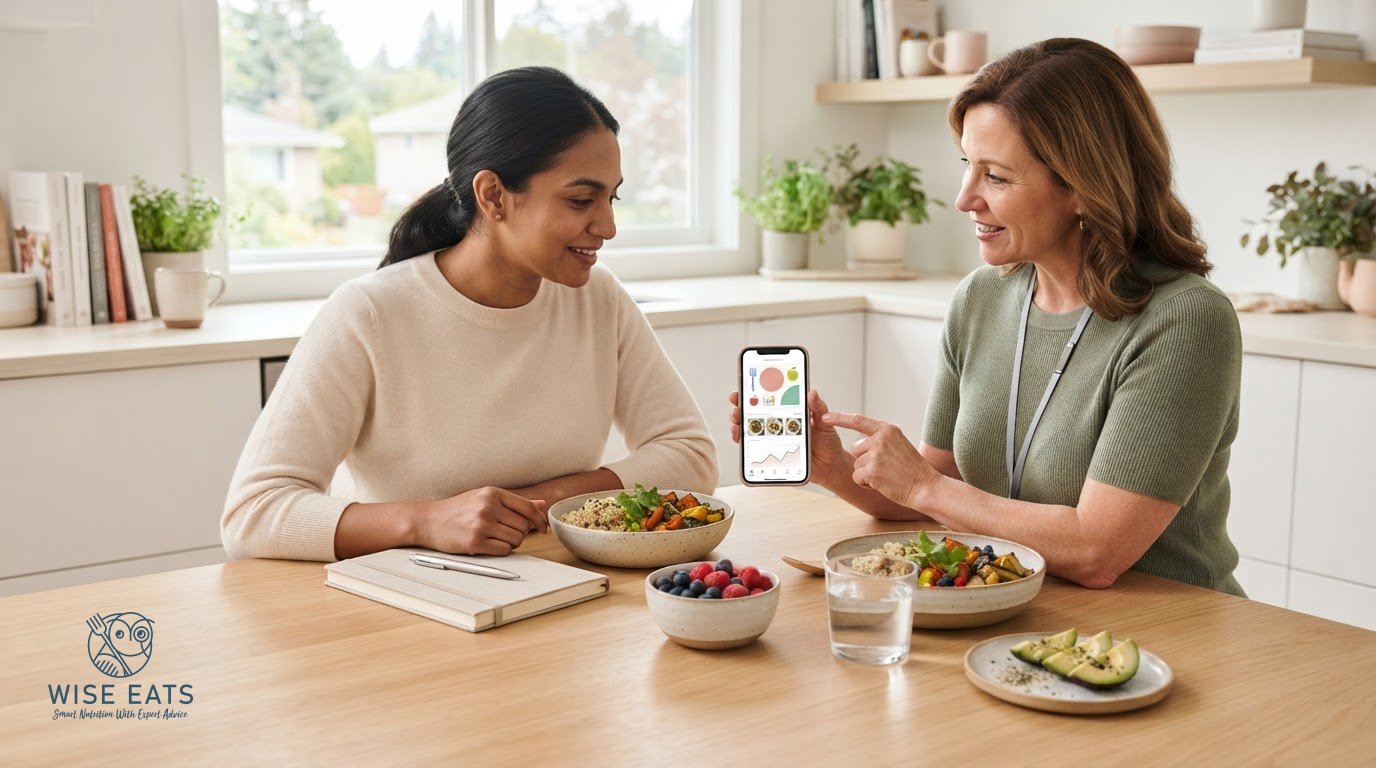
A Nutrition tracker app free of charge sounds like an easy starting point, but its free features, food database and privacy settings deserve a closer look. More tracking does not always mean better meal-planning support.
If you’re unsure which tools sit behind a paywall, or whether a food entry reflects what you ate, you’re not overthinking it. App databases and free plans differ, and detailed numbers don’t tell the whole story. A nutrient total depends on the accuracy of the food entry and serving size. Tracking should fit your needs and feel manageable, not leave you anxious about meals.
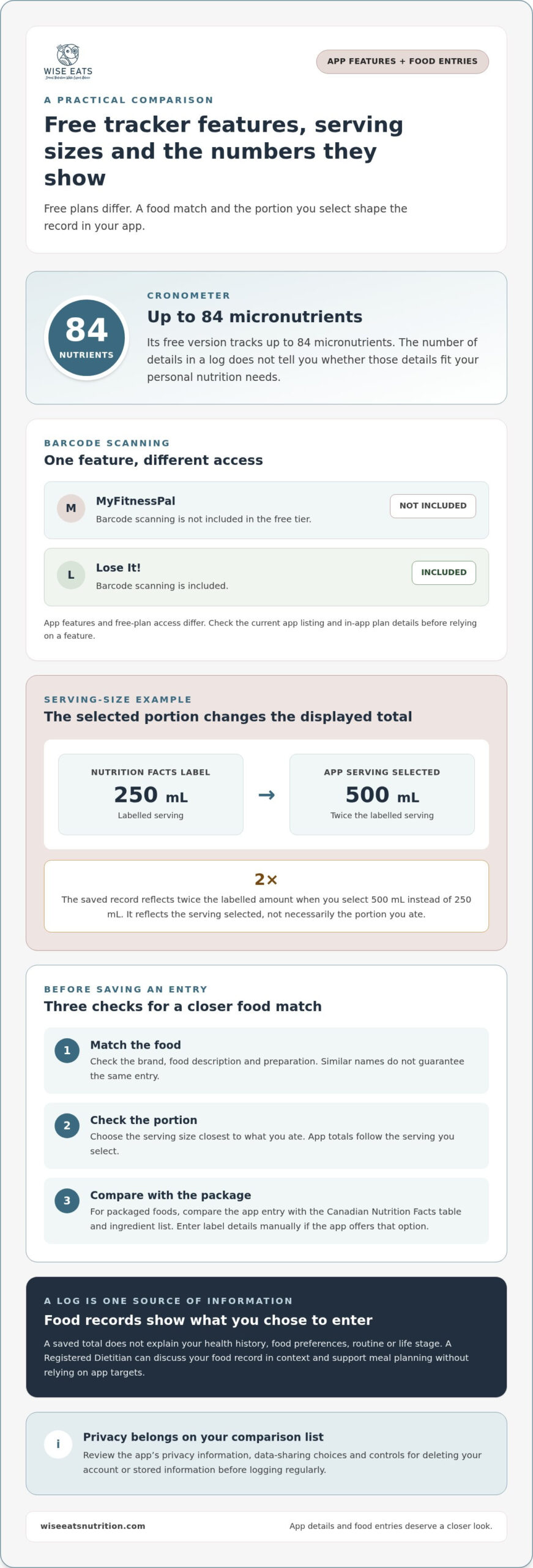
This guide reviews practical features in Cronometer and MyFitnessPal, with a note on Lose It!’s barcode scanning. As of October 2026, Cronometer’s free version tracks up to 84 micronutrients, MyFitnessPal’s free tier excludes barcode scanning, and Lose It! includes it. You’ll also learn what to check before logging, how to choose an approach that feels comfortable, and when personalized support from a Registered Dietitian offers more context than app targets.
Key Takeaways
- A Nutrition tracker app free of charge offers different tools depending on its free plan, so compare features before you start logging.
- Treat a food database match as an estimate. Check the serving size and Canadian food options before saving an entry.
- Review privacy settings and nutrient details alongside logging options to find an app suited to your needs.
- Set a clear purpose for tracking, then reassess whether the process feels useful and comfortable.
- A Registered Dietitian can put food logs in context and support meal planning without relying on app targets.
What a Free Nutrition Tracker App Does, and What It Cannot Tell You
A nutrition tracker app is a digital food log. It records information you enter, while a nutrition professional interprets it in the context of your needs. A Nutrition tracker app free to download might let you record meals, drinks, calories and selected nutrients. Tools and details vary by provider, and some features sit behind a paid plan.
Think of the log as a record of selected details, not a complete picture of your health or eating habits. A saved calorie or nutrient total reflects the entries you chose and the portions you recorded. It does not show whether those numbers suit your individual nutrition needs.
This video offers one example of how a free calorie tracker is presented. Use it as an introduction to app features, not as personalized nutrition guidance.
Which nutrition details do free apps usually record?
A typical entry includes a food or drink, a serving size and, depending on the app, calories and fields such as protein, carbohydrates, fat or fibre. You might search for an item, scan a barcode, enter a recipe or add a food manually. Free plans differ in which methods and nutrient details they include.
Before saving a packaged food, compare the app entry with the product’s Canadian Nutrition Facts table. Check the brand and serving size first, then compare the listed nutrients. A similar name or package does not guarantee a matching entry. If the app serving differs from the amount you ate, its totals reflect the selected serving, not necessarily your portion.
For general background on a familiar tracking service, the MyFitnessPal Wikipedia page outlines its history and features. It does not verify the accuracy of a particular food entry.
Why an app log is not a nutrition assessment
A food log captures what you choose to record. It might miss unlogged snacks, cooking ingredients, changes in appetite or other details relevant to your overall eating pattern. Even complete entries do not explain your health history, food preferences, daily routine or life stage.
Those details matter when someone assesses nutrition needs. A total on a screen does not determine whether your intake meets your needs, and an app score is not a diagnosis. Use the record to notice what you chose to track, not to judge your food choices or set personal targets on your own. A Registered Dietitian offers context when you need individualized guidance.
How Free Nutrition Tracker Apps Work Behind the Food Log
Most apps follow a similar logging sequence. You search for a food or scan its barcode, choose a matching result, select a serving size, then save the entry. You can review the saved details in a diary or report, depending on the app. Each choice affects what appears in your record.
- Search or scan the food, then check the brand or food description.
- Select the preparation and serving size closest to what you ate.
- Save the entry and review the information the app displays.
A database match is an estimate, not a laboratory analysis of your meal. More logging detail does not make an app’s record personally accurate, because the result depends on the food match, portion and information you enter.
Food databases, serving sizes, and Canadian products
Brand, preparation and portion all matter. A search for “oatmeal,” for example, might show plain cooked oats, a flavoured instant packet or a restaurant item. Those entries differ. Choose the closest description, and check whether the database includes Canadian foods and brands you buy rather than assuming a familiar product will appear.
Example: Suppose a packaged soup label lists nutrients for 250 mL, but you select a 500 mL serving in the app. The saved record reflects twice the labelled amount. This illustrates how serving selection changes displayed totals, not how much of any nutrient your body absorbs.
For packaged foods, compare the selected entry and serving size with the Canadian Nutrition Facts table and ingredient list. If the app result doesn’t match the package, use a closer entry or enter the label details manually if the app offers that option. A close-looking product name is not a confirmed match.
Free access, reports, and privacy settings
A Nutrition tracker app free of charge still has limits worth checking. Free access and report options differ by app, and providers change them. Before relying on a feature, review the current app listing and in-app plan details. Look for limits on food logging, barcode scanning, recipe tools, nutrient reports and saved history.
Privacy deserves the same attention as features. Before entering personal information, read the app’s privacy information and review its settings. Check what account details you provide, which data-sharing choices appear, and how to delete your account or stored information. Don’t assume one app handles personal data in the same way as another.
- Confirm which features remain available without a subscription.
- Check whether reports cover the nutrients you want to review.
- Find the account, data-sharing and deletion controls before logging regularly.
If you have a food record but feel uncertain about its meaning, a Registered Dietitian can discuss it alongside your routine and preferences through personalized nutrition counselling.
Compare Free Nutrition Tracker Apps With a Practical Checklist
The phrase “Nutrition tracker app free” often refers to an app’s free tier, not every feature it offers. Compare the functions you plan to use, then check the current app listing and settings before you start. The table below reflects the feature information available as of October 2026. App plans can change.
What to compare before choosing an app
Start with your purpose. If you want to log meals, a food diary might be enough. If you want to review specific nutrients, look closely at which details appear in the free version. Barcode scanning, recipe tools, reports and export options also differ. Confirm current access in each app, rather than assuming a feature stays free.
| What to check | Cronometer | MyFitnessPal |
|---|---|---|
| Logging | Free food diary, barcode scanning and custom recipe creation. | Free food and exercise logging and recipe creation. Barcode scanning is listed among Premium features. |
| Nutrient detail | Free tracking includes up to 84 micronutrients. | Free tracking includes basic macronutrient information as percentages. Detailed micronutrient views are largely Premium features. |
| Canadian foods | Check search results for foods and brands you buy. Compare packaged-food entries with the Canadian Nutrition Facts table. | |
| Privacy | Review each app’s privacy information and account settings for data sharing and deletion controls. | |
| Free access and reports | Free version includes ads, with reports limited to a seven-day window. | Basic logging is available free. Check the current plan details for feature limits. |
| Export options | Confirm current export options in the app listing or settings before relying on them. | |
Choose the simplest tool that meets your needs
More detail doesn’t automatically make tracking more useful. For general meal awareness, a simple diary might suit your purpose. If you have a specific reason to review nutrient information, choose an app with relevant fields and reports, then check its entries against package labels. You don’t need to track every nutrient to plan meals.
If you’d rather begin with meal ideas than app data, Wise Eats Registered Dietitians offers a free meal plan and diet analysis resource. Choose an approach that feels manageable, and review the app’s privacy controls before adding personal details. For support putting food records in context, personalized nutrition counselling offers another option.
Use a Nutrition Tracker App Without Ignoring Your Well-Being
A Nutrition tracker app free to use still needs to fit your needs and comfort. Before you log your first meal, decide what you hope to learn. You might want a clearer record of meal timing or ideas for planning weekday lunches. A specific purpose helps you focus on useful information instead of chasing every number on the screen.
A simple process for deciding whether to keep tracking
- Name your purpose. Write down a practical reason for trying the app, such as noticing your usual meal pattern. Avoid setting personal calorie, weight or nutrient targets based on app prompts.
- Choose a tool that fits. Use only the features you need. If food searches and entries take too much time, a simpler note or meal-planning method might suit you better.
- Check how it feels. After using the app for a while, notice whether the record helps you make sense of your routine or adds stress. Look for broad patterns with curiosity, such as meals you enjoy preparing or times you often forget to plan.
- Reassess your purpose. Keep tracking only if it remains useful and manageable. If distress grows, stop using the app and talk with your care team about your concerns.
Food entries don’t need moral labels. A log is a record, not a grade. You also don’t need detailed tracking to plan meals or pay attention to eating habits. If the app encourages rigid rules or leaves you preoccupied with totals, taking a break is a reasonable step.
When to Seek Help if Food Tracking Raises Concerns
Consider reaching out to your care team if food tracking starts affecting your well-being. You don’t need to wait until concerns feel severe before asking for support. These signs are reasons to talk with someone you trust or a health professional:
- Growing distress or preoccupation: Food entries, missed logs or app totals cause increasing anxiety, or thoughts about logging take up much of your day.
- Changes in eating behaviours: You notice restrictive eating, episodes of binge eating, or behaviours intended to compensate for eating, such as vomiting or excessive exercise.
- Isolation or physical symptoms: Food concerns lead you to avoid social meals or withdraw from people, or you experience physical symptoms that concern you. Talk with your care team for guidance.
A Registered Dietitian offers support for discussing food records alongside your preferences and daily routines, without treating an app score as a diagnosis or setting targets based on the app alone.
When Dietitian Guidance Adds More Than a Free Tracking App
A food log gives you recorded entries. A Registered Dietitian helps interpret those details alongside your routines, preferences, health history and questions. A Nutrition tracker app free to use does not provide this personal context or diagnose a health condition. You can bring app notes to a nutrition appointment, but you don’t need a complete log to ask for support.
What a Registered Dietitian brings to nutrition questions
Nutrition counselling starts with your concerns and what matters in your daily life. You might want ideas for meals that fit a busy schedule, support with eating behaviours, or help making sense of nutrition information. If a log raises questions about digestion or nutrients, a dietitian can discuss what it records and what it leaves out, without treating an app score as a diagnosis.
For meal structure that fits your preferences and routine, a dietitian meal plan offers more personal context than a set of app targets. Counselling does not replace medical diagnosis or the advice of your care team. Share relevant concerns with your care team, especially if they relate to a health condition or treatment.
Wise Eats’ Registered Dietitians include Rachel McBryan, RD, College of Health and Care Professionals of BC, and Sheirry Poposka, RD, Alberta College of Registered Dietitians. Their work includes personalized nutrition counselling and custom meal planning for residents of Alberta and British Columbia, including Calgary, Edmonton, Nanaimo, Parksville, Qualicum Beach and Vancouver Island.
Choose a next step that fits your situation
If you use an app, keep it optional. Bring a few entries or questions to an appointment if they help explain what you want to discuss. You might ask how to plan meals around your schedule, how to approach a food concern, or whether an app’s information answers the question you have. If tracking feels stressful, leave the log behind and talk about the concern instead.
For an overview of what to expect from nutrition counselling, learn about working with a dietitian. A collaborative conversation can focus on practical meal planning, digestive health, eating behaviours or another nutrition concern. Your care team remains part of the picture for medical questions and diagnosis.
Speaking with a registered dietitian can help you develop a balanced, flexible approach to eating and meet your nutritional needs.
Choose a Next Step That Fits Your Life
A Nutrition tracker app free of charge is one possible tool, not a requirement for meal planning. For your next step, choose one practical change to explore, such as keeping ingredients for a simple lunch on hand or finding a meal rhythm that suits your schedule. Start with what feels realistic, then adjust as your needs and routines shift.
If app numbers leave you unsure, bring your questions to personalized nutrition counselling with a Registered Dietitian. Wise Eats supports residents of Alberta and British Columbia with guidance shaped around individual needs, preferences and everyday routines. You don’t need a perfect food log or a list of targets before asking for help. A question about meal planning is enough to begin.
Choose the kind of support that feels comfortable for you. A conversation with a dietitian offers room to discuss your goals without treating app scores as a measure of your worth or health.
Your next meal plan can start with one small, useful choice, made in a way that respects your time, preferences and well-being.
Frequently Asked Questions
Is a free nutrition tracker app enough to understand my diet?
It offers a record of selected meals and nutrients, but it doesn’t explain how food fits your health history, preferences or daily routine. For example, a diary might show when you tend to eat lunch, yet not explain how work shifts affect your meal choices. Use app information as a starting point for reflection, not as a full assessment of your nutrition needs.
How do I choose a free nutrition tracker app in Canada?
Start with the task you want the app to support, such as recording meals or reviewing a specific nutrient. Check its current free features, Canadian food search results, accessibility settings and privacy controls. Then try a few typical entries, including a meal you prepare at home. If the setup feels cumbersome or the information you want requires a paid feature, another tracking method might suit you better.
Are nutrition tracker apps accurate for Canadian foods?
Accuracy depends on the specific food entry and the details you select. For shoppers in Calgary, Edmonton, Nanaimo, Parksville, Qualicum Beach and Vancouver Island, local store products and package sizes might differ from entries in an app’s database. Check the brand and package information before saving an item. A product’s label can also change, so an old saved entry might not reflect its current package.
What happens to my food and health data in a tracking app?
Each provider sets out how its app collects and handles account and health information. Before signing up, read the privacy details and look for controls related to data sharing, connected services and account deletion. Share only details needed for the features you plan to use. If you stop using the app, review its deletion steps rather than assuming removing it from your phone erases your account.
Should I track calories if food logging feels stressful?
No. You don’t need to track calories if the process causes stress or takes attention away from eating and daily life. Pause or stop logging, and consider discussing the distress with your care team. If meal planning is your main goal, try a short grocery list or a note with meal ideas instead. Those options offer structure without calorie totals.
Can a nutrition tracker app replace a Registered Dietitian?
No. An app organizes information, but it doesn’t offer a collaborative conversation about your needs, preferences or concerns. A Registered Dietitian can help you discuss questions such as how to plan meals around changing work hours or food preferences. Nutrition counselling doesn’t diagnose medical conditions or replace your care team. You decide whether app notes are useful to bring to an appointment.
When should I stop using a food tracking app and seek help?
Pause tracking and talk with your care team if logging causes growing distress or preoccupation with food entries. Seek support if you notice restrictive eating, binge eating or behaviours intended to compensate for eating. Social withdrawal around meals or physical symptoms that concern you are also reasons to reach out. You deserve support, and you don’t need a complete food record before asking for it.
Article by
Rachel McBryan, Dietitian
Rachel McBryan is a licenced Dietitian in British Columbia offering comprehensive nutrition counselling as virtual and/or in-person counselling sessions to suit your needs and preferences. With a Bachelor of Science in Nutrition and Food Science, Rachel has over 20 years experience helping people address their health through nutrition. She was awarded Human Nutrition and Food Science BSc.from University of Alberta followed by post-grad course work at UBC in guidance counselling.
An eating disorder is a serious mental health illness.
If you are in immediate distress or crisis, please contact emergency services by dialing 911 or calling Vancouver Island Crisis Line: 1-888-494-3888.