A food label is information, not a verdict. When serving sizes differ, comparing similar products gets confusing fast. These tips for reading food labels help you focus on details tied to your needs, without treating a number or claim as a scorecard for your choices.
Nutrition terms and marketing messages can feel like a lot to sort through. If label reading brings worry or judgement to the table, a practical, non-judgmental approach can help. Food choices also reflect your preferences, culture and daily life.
In Canada, many prepackaged foods high in sodium, sugars or saturated fat require a front-of-package symbol. It offers a quick cue, while the Nutrition Facts table and ingredient list provide more detail. The symbol doesn’t tell you whether a food fits your needs.
This guide covers serving sizes, % Daily Value and common label claims. You’ll also find a simple way to compare products and guidance on when a Registered Dietitian can help put label details in context, especially if reading them feels stressful or your health needs call for extra support.
Key Takeaways
- Use tips for reading food labels to focus on details tied to your needs, rather than treating the package as a scorecard.
- Check the serving size first, then compare matching amounts of similar products.
- Use the Nutrition Facts table and ingredient list for different kinds of information about a food.
- Follow a simple grocery-aisle method to compare products based on what matters to you.
- A Registered Dietitian can help you understand label details in the context of your health needs and eating habits.
Tips for Reading Food Labels: Start with What the Package Tells You
In front of several similar packages, you might wonder whether to compare calories, ingredients or a claim on the front. It’s understandable to feel unsure. Start with one useful idea: a label gives selected information about a product. It doesn’t measure your overall eating pattern or decide which foods belong in your meals.
Canadian packaged foods often display a Nutrition Facts table, an ingredient list, allergen details and front-of-package information. Each part answers a different question. You don’t need to inspect every detail on every trip. Start with the information tied to your reason for choosing a product.
What information appears on a Canadian packaged-food label?
Think about a tub of yoghurt. The Nutrition Facts table shows the listed serving size and nutrient amounts, helping you check what a portion provides. The ingredient list names what went into the product. The Canadian Food Inspection Agency (CFIA) says ingredients appear in descending order by weight. The first item weighs more than each one listed after it, offering a clue about the product’s composition.
Allergen information helps you identify declared priority allergens and gluten sources. If allergies or celiac disease affect your food choices, read the ingredient list and any “Contains” statement carefully. Front-of-package details serve a different role. Since January 1, 2026, many prepackaged foods meeting Canadian criteria for high sodium, sugars or saturated fat display a black-and-white magnifying-glass symbol naming the flagged nutrient or nutrients. Exemptions apply to some foods and packages.
Health Canada sets food-labelling requirements, and the CFIA oversees compliance. The U.S. Food and Drug Administration’s Nutrition Facts guidance covers U.S. labels, so its examples don’t always match Canadian packages. For a general overview of Canadian rules, see Wikipedia’s Canadian Food Labelling Regulations page alongside guidance from Canadian regulators.
Why one label does not tell the whole story
A label doesn’t describe every part of a food or eating experience. It doesn’t show how a product fits into a meal, how satisfying it feels to you, or how it connects with your culture and preferences. Those details matter too.
The most relevant label details depend on your circumstances. An allergen declaration might be essential for one person. Someone following care-team guidance for a health condition might focus on a particular nutrient. Another shopper might prioritize taste, convenience, ingredients or how a food works in a family meal. Each is a valid reason to choose a product.
You don’t need to study every number or compare every package. Pick one detail tied to your needs, then set the label aside once it has helped. Food labels offer product information, not a scorecard for your choices or your overall diet.
How to Read the Canadian Nutrition Facts Table
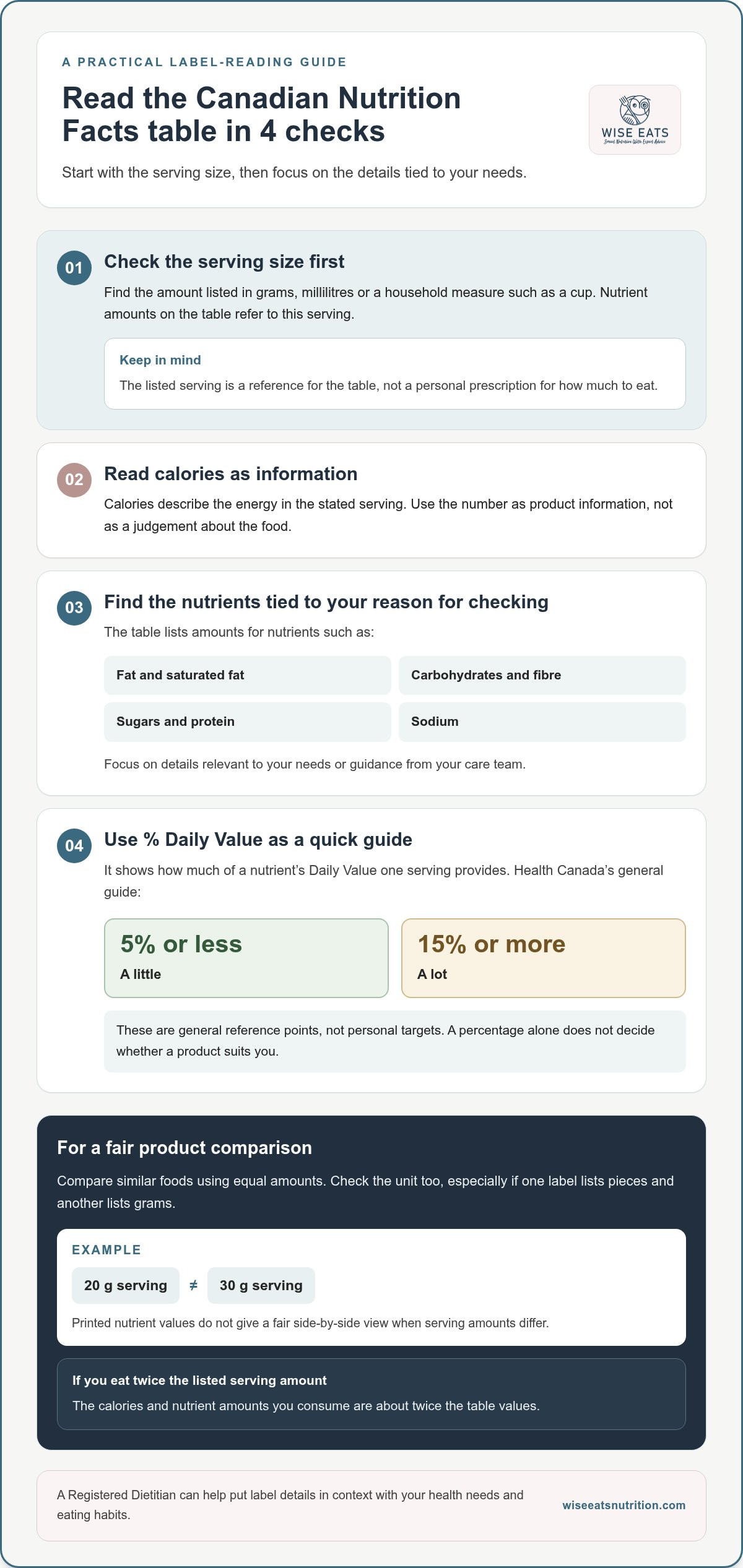
A quick reading order helps you focus on the numbers tied to your question. Health Canada’s Nutrition Facts table lists nutrients for a stated serving size, so start there before comparing products or portions. The serving shown is a reference amount for the table, not a personal prescription for how much to eat.
- Check the serving size. Note the amount in grams, millilitres or a household measure such as a cup. Compare the listed amounts on similar foods before looking at their nutrient numbers.
- Look at calories. Calories describe the energy in the stated serving. Read the number as information, not as a judgement about the food.
- Find nutrients tied to your reason for checking. The table lists amounts for nutrients such as fat, saturated fat, carbohydrates, fibre, sugars, protein and sodium. Focus on details relevant to your needs or guidance from your care team.
- Use % Daily Value as a quick guide. It shows how much of a nutrient’s Daily Value one serving provides. Health Canada’s general guide says 5% Daily Value or less is a little, and 15% or more is a lot.
Serving size, calories, and nutrient amounts
The package size and the serving size on the table aren’t always the same. A bag of crackers might contain several listed servings, even if you eat from it over more than one sitting. If you eat twice the listed serving amount, the calories and nutrient amounts you consume are also about twice the table values.
Serving sizes also affect product comparisons. Suppose one cracker label lists values for 20 g and another lists values for 30 g. Comparing the printed numbers alone won’t give you a fair side-by-side view. Compare equal amounts, or use the listed servings as a starting point and account for the difference. Check the unit carefully, especially if one label uses pieces and another uses grams.
Using percent Daily Value with care
Use % Daily Value to get a quick sense of how much of a nutrient a serving contributes. The 5% and 15% guideposts are general reference points, not personal targets. Daily Values offer a common benchmark, but your needs differ based on your health, eating habits and care plan. A percentage by itself doesn’t decide whether a product suits you.
For example, a cereal with 15% Daily Value for fibre provides a larger share of the reference value per listed serving than one with 5%. The comparison describes those servings, not the whole meal or your day. If a health condition makes a particular nutrient important to monitor, a Registered Dietitian can help put label details in context alongside your preferences and usual eating habits. You can view nutrition session options for support with food-label questions and your needs.
Compare Ingredients, Allergen Details, and Front-of-Package Information
The Nutrition Facts table gives nutrient amounts for a serving. The ingredient list tells you what the product contains. Both add useful context, but they answer different questions.
| Label area | What it helps you check |
|---|---|
| Nutrition Facts table | How much of listed nutrients a serving provides. |
| Ingredient list | Which ingredients make up the product. |
| Allergen information | Whether declared priority allergens or gluten sources appear. |
| Front-of-package symbol | Whether the product meets criteria for a “high in” symbol for certain nutrients. |
Ingredient lists and allergen information
Ingredients appear in descending order by weight, according to the Canadian Food Inspection Agency (CFIA). The first item weighs more than each ingredient listed after it. For example, a soup’s list might begin with water, tomatoes or broth. The order offers a clue about what goes into the product, but one ingredient alone doesn’t tell you whether a food suits your needs.
In Canada, priority allergens and gluten sources must appear in the ingredient list or a “Contains” statement. Priority allergens include milk, eggs, peanuts, tree nuts, sesame, soy, wheat, mustard, fish, crustaceans and molluscs, and sulphites. Read the label each time you buy a product, since ingredients and packaging can change. If you have a food allergy or need to avoid gluten for a medical reason, use guidance from your care team for personal safety decisions. General label-reading tips cannot assess your individual risk.
Claims and front-of-package symbols
A package claim and the Nutrition Facts table serve different purposes. A claim such as “source of fibre” highlights a specific product feature. The table shows nutrient amounts for its stated serving, and the ingredient list names what’s included. Use the claim as a prompt to check more detail, not as a complete description of the food.
Health Canada’s front-of-package labelling rules took full effect on January 1, 2026: many prepackaged foods meeting specified thresholds for sodium, sugars or saturated fat must show a black-and-white magnifying-glass symbol stating “High in” the relevant nutrient or nutrients, with “Health Canada / Santé Canada” below. The symbol offers a quick cue, not a full nutrition profile. Health Canada lists exemptions, including certain dairy products, some raw single-ingredient meats, plain fruits and vegetables, and very small packages. Older packaged products can also remain on store shelves during the transition.
These tips for reading food labels help separate product information from marketing language. If a health condition or allergy makes label details hard to interpret, a Registered Dietitian can help you consider them alongside your needs and usual eating habits.
A Simple Grocery-Aisle Method for Comparing Food Labels
Two similar packages can show different serving amounts, claims and nutrient figures. Start with the reason you’re comparing them. These tips for reading food labels offer a simple process you can repeat without searching for one product that suits everyone.
Three steps for a useful product comparison
- Name your question. Decide what matters for this purchase. You might compare fibre in two breakfast cereals, sodium in two soups, or ingredients in similar crackers. One clear question helps you avoid getting pulled into every number and claim on the package.
- Check serving amounts, then compare. Look at the serving size listed in each Nutrition Facts table before comparing nutrient amounts. For example, if one cereal lists a serving of 30 g and another lists 40 g, their printed fibre values describe different amounts of food. Compare equal weights, or account for the difference before drawing a conclusion. If you follow nutrient guidance from your care team, use that guidance rather than applying a general target to everyone.
- Consider the rest of the choice. Review the ingredient list or allergen information if these details matter to you. Then consider taste, convenience, texture and how each product fits the meal or snack. A cereal you enjoy with fruit or yoghurt might suit your routine better than an option you’re unlikely to eat. Your preferences count.
You don’t need to compare every nutrient on the shelf. Once you’ve answered your question, you have enough information for this decision. Other details can wait until they’re relevant to a future choice.
When to Seek Help
Label reading deserves support if it starts to create stress or get in the way of eating. Consider talking with a Registered Dietitian or another member of your care team if:
- Checking labels disrupts meals, social eating or daily routines.
- Food rules or distress around labels make eating feel harder.
- You avoid more foods over time or feel isolated because of label concerns.
These experiences don’t mean you’ve done anything wrong. A Registered Dietitian can help put food information in context with your health needs, preferences and eating habits. If a medical condition or allergy affects your choices, discuss personal questions with your care team rather than relying on a general comparison method.
Use Food Labels in a Way That Fits Your Health and Eating Needs
Label information becomes more relevant when it connects to a health need, allergy or care plan. General guidance helps explain what the package says, but it can’t tell you which foods to choose or set personal nutrition goals. Your needs, food preferences, routines and the advice of your care team all matter.
When personalized nutrition guidance adds context
A Registered Dietitian can help you interpret label details alongside your health needs and usual eating habits. For example, they can help you prepare questions about a nutrient listed on a package and discuss how the information fits with guidance from your care team. This support doesn’t replace medical care, diagnose a condition or promise a health outcome.
Condition-specific nutrition support is different from general label-reading advice. A Registered Dietitian can help you sort through questions about food choices without turning one number into a rule for every meal. If you’re unsure how label information applies to your situation, start with a dietitian’s response to a nutrition question.
A supportive next step with a Registered Dietitian
For residents of Alberta and British Columbia, nutrition sessions are available online and in person. Rachel McBryan, RD, College of Health and Care Professionals of BC, and Sheirry Poposka, RD, Alberta College of Registered Dietitians, offer guidance shaped by personal health needs, preferences and eating habits. Wise Eats Registered Dietitians supports clients in Calgary, Edmonton, Nanaimo, Parksville, Qualicum Beach and across Vancouver Island.
You might bring a label that’s been hard to interpret, or note which parts of food choices feel stressful. Together, you and your dietitian can discuss your questions and consider what information is useful for your circumstances. The aim is practical support, not a rigid set of food rules.
These tips for reading food labels offer a starting point. If label details leave you uncertain about a health-related food choice, a conversation with a Registered Dietitian can help you put the information in context.
Let Your Food Choices Reflect Your Needs
Let food labels support your decisions without asking them to make every decision for you. The next time a package raises a question, pause and consider what information would help. You don’t need to understand every claim or number before choosing food. A label is one source of product information, and your experience, preferences and care needs matter too.
If label reading brings stress or leaves you unsure how to apply nutrition guidance, talking with a Registered Dietitian offers space to discuss your concerns in context. These tips for reading food labels are a starting point, not a personal nutrition plan. Support can help you find an approach that respects your health needs and feels manageable in daily life.
You deserve food guidance that feels respectful and useful, with room for your needs and preferences.
Frequently Asked Questions
Are Nutrition Facts tables required on every packaged food in Canada?
No. Canadian labelling rules include exemptions and special cases, so some packaged foods don’t display a Nutrition Facts table. Its absence doesn’t mean a product has no nutritional value. Whether you’re shopping in Calgary, Edmonton, Naniamo, Nanaimo, Parksville, Qualicum Beach or elsewhere on Vancouver Island, check current Health Canada or Canadian Food Inspection Agency guidance for the product category. For allergy or health concerns, ask your care team about the specific product.
What is the difference between a best-before date and an expiration date?
A best-before date relates to the quality of a food when properly stored. An expiration date applies only to specific products under Canadian rules. Check the package for storage and handling instructions, and follow current food-safety guidance if you’re unsure about a product. Neither date tells you about the food’s nutrient content, so use date information for freshness and safety questions, not to compare Nutrition Facts table values.
Does serving size on a Nutrition Facts table tell me how much to eat?
No. The serving size provides a reference amount for the nutrient information, not a personal eating target. Your appetite, schedule, health needs and the rest of your meal all affect what feels right for you. For example, a snack portion might differ from the amount listed on a package. Use the table’s amount to understand its figures, and seek support if serving-size numbers cause distress.
How do I compare two products with different serving sizes?
Start by checking the units and amounts listed on both tables. If one peanut butter label gives values for 15 g and another for 30 g, double the first product’s figures to compare an equal 30 g amount. Focus on the nutrient or ingredient linked to your reason for choosing between them. These tips for reading food labels support a comparison, but one nutrient number doesn’t define a food’s place in your meals.
What does a front-of-package nutrition symbol mean in Canada?
The black-and-white magnifying-glass symbol identifies a prepackaged food as “High in” sodium, sugars, saturated fat, or more than one of these nutrients under Canadian criteria. It’s a quick cue, not a full description of the product or a direction to avoid it. Some product categories and packages have exemptions, so no symbol doesn’t necessarily mean a food contains little of these nutrients. Check Health Canada guidance for current details.
What does a “may contain” statement mean on a food label?
A “may contain” statement warns of possible unintended allergen presence, often linked to contact during production. Manufacturers use different wording, and the statement doesn’t replace your allergy care plan. If you have a food allergy, follow advice from your allergist or care team when deciding whether a product is suitable for you. Don’t rely on general label-reading guidance to assess your personal allergy risk.

Article by
Rachel McBryan, Dietitian
Rachel McBryan is a licenced Dietitian in British Columbia offering comprehensive nutrition counselling as virtual and/or in-person counselling sessions to suit your needs and preferences. With a Bachelor of Science in Nutrition and Food Science, Rachel has over 20 years experience helping people address their health through nutrition. She was awarded Human Nutrition and Food Science BSc.from University of Alberta followed by post-grad course work at UBC in guidance counselling.
An eating disorder is a serious mental health illness.
If you are in immediate distress or crisis, please contact emergency services by dialing 911 or calling Vancouver Island Crisis Line: 1-888-494-3888.