
What if understanding how to build healthy habits that last has nothing to do with strict willpower? Thousands of busy adults across Alberta and British Columbia blame themselves when an aggressive diet collapses after a few weeks. You fill your kitchen with unfamiliar groceries, follow restrictive rules, and feel like a failure when work or family obligations disrupt the plan. Trying to change every single daily pattern at once leads straight to mental exhaustion. Conflicting nutrition trends on social media only add more confusion to the process. Your frustration makes complete sense.
Real progress thrives on sustainable nourishment rather than strict deprivation. In this guide, you will learn science-backed strategies to nourish your body, support daily energy, and design routines suited to your schedule in Calgary, Edmonton, or Vancouver Island. We examine practical methods to quiet food anxiety, simplify weeknight meals through custom planning, and foster a peaceful relationship with food without chronic stress.
Key Takeaways
- Work with your biology instead of fighting it by understanding how automatic brain patterns and set point theory influence daily health.
- Learn how to build healthy habits that last by focusing on steady nourishment and flexible choices like the Mediterranean eating pattern.
- Attach tiny nutrition actions to established daily routines through habit stacking to simplify busy mornings and evenings.
- Approach routine disruptions with self-compassion to protect your momentum without guilt or frustration.
- Collaborate with a Registered Dietitian to receive individualized guidance and Medical Nutrition Therapy designed for your health goals.
Why Most Habits Fail and How to Start Differently
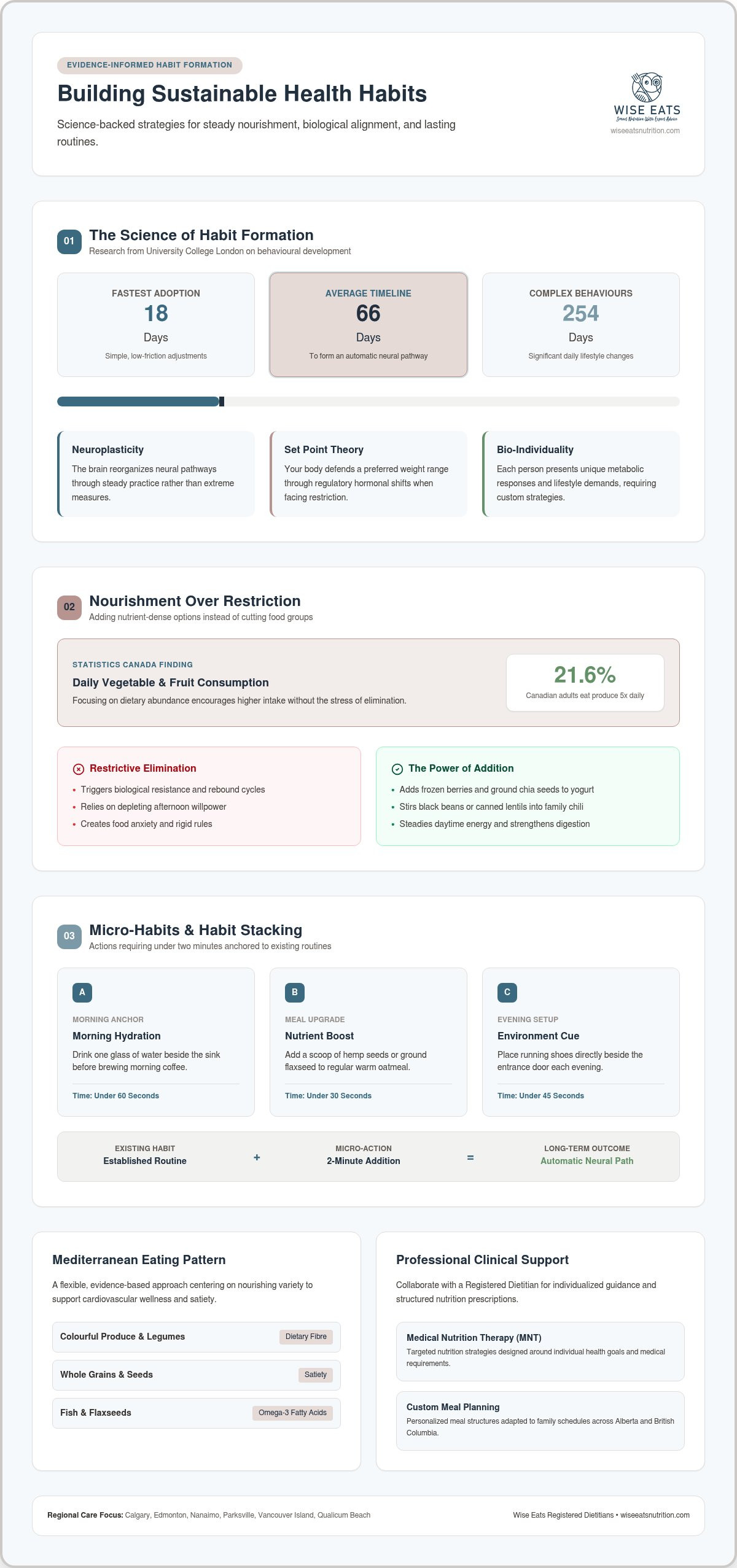
Habits are automatic behaviours created by your brain to conserve energy. When you repeat a routine, your brain builds neural pathways running on autopilot, freeing mental focus for complex tasks. Research from University College London shows an average of 66 days to form a new health behaviour, with the full timeline ranging from 18 to 254 days. Understanding the science of habit formation reveals why dramatic changes trigger biological resistance. Through neuroplasticity, your brain reorganizes neural pathways, though this process requires steady practice instead of extreme measures. In addition, set point theory explains how your body actively defends a preferred weight range through regulatory hormonal shifts, explaining why aggressive deprivation fails. Embracing Bio-individuality acknowledges unique metabolic responses and distinct lifestyle demands, which means generic plans rarely succeed.
To better understand why daily routines break down, watch this helpful video:
The Myth of Willpower in Health
Willpower works like a muscle tiring by late afternoon. Relying on sheer determination usually locks people into a frustrating cycle of rigid perfection followed by complete abandonment. Instead of white-knuckling your routine, adjust your immediate environment to make supportive choices straightforward. Placing a water pitcher on your desk or keeping washed fruit in plain view removes mental friction and protects your focus after demanding workdays in Edmonton or Calgary.
Starting Small with Micro-Habits
Micro-habits are manageable actions requiring under two minutes to finish. These tiny steps prevent decision fatigue and create consistent momentum without overwhelming your daily calendar. If you want to know how to build healthy habits that last, start with simple additions:
- Drink one glass of water beside the sink before your morning coffee
- Add a scoop of hemp seeds or ground flaxseed to your regular oatmeal
- Place your running shoes beside the entrance each evening
Accumulating small wins develops self-trust and shows how to build healthy habits that last over years rather than weeks.
Shifting Your Focus from Restriction to Nourishment
Traditional diet culture demands elimination, urging people to cut out entire food groups and attach guilt to everyday meals. An anti-diet approach flips this mindset entirely, asking what wholesome items you need to add rather than what you must remove. Statistics Canada reports only 21.6% of Canadian adults consume vegetables or fruits five times daily. Focusing on abundance makes healthy eating feel generous. The Mediterranean eating pattern provides a flexible, evidence-based framework centered on colourful produce, legumes, whole grains, seeds, and fish rich in Omega-3 fatty acids. Combining adequate fibre with quality protein promotes satiety, steadies daytime energy, and strengthens digestive wellness alongside long-term cardiovascular health. This mindset shows how to build healthy habits that last without unnecessary friction.
The Power of Addition in Your Meals
Adding nourishing ingredients transforms your relationship with food while protecting you from deprivation. Instead of skipping breakfast, blend a cup of frozen berries and a spoonful of ground chia seeds into Greek yogurt. Stir a cup of black beans or canned lentils into weeknight chili. Small nutritional upgrades accumulate quickly. If organizing balanced grocery lists feels overwhelming, personalized custom meal planning offers structured, practical guidance tailored to your household schedule.
Understanding Your Body’s Internal Cues
Reconnecting with your body forms another essential pillar of sustainable nutrition. Listening closely to natural hunger and fullness cues frees you from rigid counting methods and arbitrary rules. Honoring early hunger signals prevents extreme drops in blood sugar, eliminating the cycle of late-evening overeating. Adequate hydration also protects daily vitality, as even mild fluid deficits drain mental clarity. Developing awareness around your habits requires patience, especially when navigating roadblocks and setbacks during busy periods.
If you want supportive, non-judgmental nutrition guidance, book an initial consultation with a Registered Dietitian to start building your personalized routine.
Practical Strategies for Habit Stacking
Habit stacking links a novel behaviour to an existing routine already hardwired into your brain. Instead of scheduling a detached task during a hectic day, you anchor the new action to something you perform automatically. This method removes the cognitive load of remembering new commitments. A clinical nutrition prescription created alongside an expert provides a structured roadmap for these sequences, making healthy eating feel manageable. Many clients discover that partnering with a registered dietitian helps identify realistic anchors for daily nourishment.
Designing Your Habit Stack
Creating an effective habit stack requires pairing compatible activities. Select an established anchor habit like brushing your teeth, starting the dishwasher, or boiling the kettle. Next, attach your chosen nutritional action immediately after that anchor event. Use this clear sequence formula: After I [Anchor Action], I will [New Action].
Here are three practical examples for your home:
- After I start the morning coffee maker, I will fill a 1-litre water bottle for my desk.
- After I unpack groceries on Sunday, I will wash celery sticks and baby carrots for accessible snacks.
- After I finish clearing the dinner table, I will place my morning vitamin supplements on the counter.
Consistency in the first month matters far more than flawless performance. Missing an occasional day happens to everyone. Return to your sequence at the next opportunity without self-criticism to protect your confidence.
Tracking Progress Without Obsession
Monitoring your habits should offer reassurance rather than trigger anxiety. Mark a paper wall calendar with a simple checkmark or use a straightforward notes application on your phone. Avoid tracking calories, measuring food grams, or relying entirely on bathroom scales. Those traditional metrics often trigger obsessive thoughts and distort your self-worth. Evaluate your progress through tangible lifestyle indicators:
- Sustained physical energy throughout long afternoons at work
- Improved bowel regularity and reduced digestive discomfort
- Better sleep quality and waking up refreshed
- A calm, relaxed mindset around family dinners
Mastering this observational approach demonstrates how to build healthy habits that last across any season of life.
Navigating Setbacks and Recognizing When to Seek Help
Setbacks form a natural part of developing new routines. When an intended behaviour falls apart, it rarely indicates a lack of discipline. More often, the initial goal demanded too much time or energy from an already full schedule. Treating these moments as practical data rather than moral shortcomings allows you to adjust the difficulty. Shrink the habit down until it fits your current capacity. True resilience comes from self-compassion, which lets you reset after a disrupted week without shame. Learning how to build healthy habits that last involves refining your plan to survive real-world chaos.
When to Seek Help: Red Flags to Watch For
Health routines sometimes drift into rigid patterns that cause emotional or physical distress. If your wellness targets begin to control your thoughts, pay attention to these warning signals:
- Intense Guilt: Experiencing distress, anxiety, or remorse after consuming items not included in your original meal plan.
- Social Isolation: Skipping restaurant gatherings, family birthdays, or holiday dinners to avoid items prepared outside your personal kitchen.
- Physical Symptoms: Enduring chronic exhaustion, digestive distress, lightheadedness, or irregular menstrual cycles due to inadequate energy intake.
The Role of Professional Support
Navigating complicated health goals becomes far simpler with dedicated clinical guidance. A Registered Dietitian provides non-judgmental accountability, ensuring your daily habits support long-term vitality without obsessive control. Virtual consultations deliver clinical expertise directly to your home in Calgary, Edmonton, Nanaimo, or Parksville. If health routines begin feeling overwhelming, working with an Eating Disorder Recovery Dietitian offers compassionate guidance to rebuild trust in your appetite and cultivate true food freedom.
How a Registered Dietitian Supports Your Journey
A Registered Dietitian is a regulated medical professional who translates complex nutritional science into individualized daily routines. In British Columbia, practitioners register under the College of Health and Care Professionals of BC, while Alberta clinicians maintain credentials through the College of Dietitians of Alberta. Clinicians such as Rachel McBryan, RD, and Sheirry Poposka, RD, apply Medical Nutrition Therapy (MNT) to help people manage chronic conditions like diabetes, digestive disorders, or elevated cholesterol. With roughly 30% of Canadians living with diabetes or prediabetes according to Diabetes Canada, tailored nutritional therapy offers clinical protection without unnecessary dietary limits. Professional care bridges the gap between scientific theory and practical kitchen decisions, demonstrating how to build healthy habits that last.
Personalized Planning for Bio-individuality
Bio-individuality means your digestive tract, genetic background, and daily schedule require distinct solutions. Custom meal planning eliminates evening decision fatigue by mapping realistic grocery lists around your family preferences, including simple dinner ideas like Sheet-Pan Lemon Herb Salmon with Roasted Vegetables. Professional supplement reviews provide essential safety oversight. Certain over-the-counter vitamins interact directly with prescription medications via the Cytochrome P450 system in your liver. Choosing items with a Health Canada Natural Product Number ensures verified quality. To receive custom support tailored to your unique metabolic profile, book a virtual consultation with our clinical team.
Accessing Care Across Alberta and BC
Virtual appointments eliminate travel barriers for residents across Calgary, Edmonton, Nanaimo, Parksville, and Qualicum Beach. You connect securely from your kitchen table between workday responsibilities. Many workplace Employee Assistance Program (EAP) packages and extended health benefit policies cover these professional appointments, removing direct financial stress from your care. Partnering with a dedicated nutrition expert provides ongoing validation and realistic adjustments, ensuring you understand how to build healthy habits that last through every phase of life.
Start Your Sustainable Nutrition Routine Today
Long-term wellness never depends on sudden overhauls or rigid rules. Instead, building lasting change requires patience, micro-steps, and nourishing foods. Daily actions stack into automatic routines over time, protecting your energy and mental clarity. Working alongside licensed professionals removes the exhausting guesswork from nutrition. Registered Dietitians Rachel McBryan, RD, regulated by the College of Health and Care Professionals of BC, and Sheirry Poposka, RD, regulated by the Alberta College of Registered Dietitians, deliver evidence-based Medical Nutrition Therapy. Their collaborative guidance honours your personal schedule, showing you how to build healthy habits that last through hectic workdays, family meals, and seasonal shifts.
If you struggle with digestive discomfort, complex medical conditions, or a stressful relationship with food, compassionate clinical support provides immediate relief. A tailored nutrition plan adapts to your daily routine in British Columbia or Alberta.
Self-compassion keeps you moving forward whenever disruptions occur. Choose one manageable micro-habit this morning, celebrate your daily wins, and give yourself permission to grow at your own pace.
Frequently Asked Questions
How long does it really take to form a new habit?
It takes an average of 66 days for a new habit to feel automatic, according to research from University College London. Depending on the complexity of your routine and your daily environment, the process can range anywhere from 18 to 254 days. Simple micro-actions solidify much faster than drastic lifestyle overhauls. Focusing on consistent daily practice rather than an arbitrary timeline helps you understand how to build healthy habits that last.
What is the difference between a Registered Dietitian and a nutritionist?
A Registered Dietitian is a regulated medical professional held to provincial standards, whereas the title nutritionist is not regulated in Alberta or British Columbia. Dietitians complete accredited university degrees, supervised clinical internships, and rigorous licensing exams. In Alberta, they register with the College of Dietitians of Alberta. In British Columbia, they register under the College of Health and Care Professionals of BC, allowing them to provide Medical Nutrition Therapy safely.
Can I build healthy habits without counting calories?
Yes, counting calories is completely unnecessary for building lasting wellness routines. Tracking numbers often creates chronic mental stress and pulls attention away from your body’s natural signals. You can nourish yourself by following balanced proportions of protein, whole grains, and colourful produce. Listening to internal hunger and fullness cues establishes a peaceful relationship with food that sustains physical energy without tedious logging apps.
Are dietitians covered by health insurance in Canada?
Most private and employer extended health insurance plans across Canada cover services provided by a Registered Dietitian. Many workplace Employee Assistance Program (EAP) packages also provide funded nutrition counselling sessions. While provincial health plans do not always cover private clinics directly, receipts from licensed dietitians qualify as eligible medical expenses on your federal income taxes. Contact your insurance provider to verify your specific policy allowances and annual coverage limits.
What should I do if I keep failing at my new habits?
If a habit repeatedly breaks down, treat it as a design flaw in the plan rather than personal failure. Most people struggle because their initial target was too ambitious for a demanding schedule. Scale the action down into a micro-habit that takes less than two minutes to finish. Practising self-compassion keeps you engaged, showing how to build healthy habits that last even during unpredictable work weeks in Edmonton or Vancouver Island.
Is it better to change one habit at a time or several at once?
Focusing on one habit at a time delivers far superior long-term results compared to overhauling multiple behaviours together. Shifting several routines simultaneously overloads your mental willpower and leads to rapid burnout. Once a single small action feels completely effortless, such as drinking water before morning coffee, you can comfortably add another layer. Building sequential micro-steps creates durable lifestyle change without triggering biological or emotional resistance.
How do I know if my new health habits are becoming too restrictive?
Health habits become overly restrictive when they produce intense guilt, emotional exhaustion, or social avoidance. If you decline dinner invitations with friends in Calgary or obsess over ingredient labels, your routine has drifted into unhelpful territory. Physical warning signs include persistent fatigue, dizzy spells, and disruptive sleep patterns. When food rules dominate your daily thoughts, consulting a Registered Dietitian helps you re-establish balance and food freedom.
What advice does a dietitian give for busy families in Calgary?
Dietitians recommend simplifying weeknight dinners through structured meal planning and batch preparation. Families in Calgary balance demanding schedules between school, winter sports, and commute times. Keeping versatile staples on hand, like pre-cut frozen vegetables, canned beans, and whole grain pasta, ensures quick dinners without decision fatigue. Enlisting household members to assemble sheet-pan meals reduces stress and supports regular family meal times without relying on rigid rules.

Article by
Rachel McBryan, Dietitian
Rachel McBryan is a licenced Dietitian in British Columbia offering comprehensive nutrition counselling as virtual and/or in-person counselling sessions to suit your needs and preferences. With a Bachelor of Science in Nutrition and Food Science, Rachel has over 20 years experience helping people address their health through nutrition. She was awarded Human Nutrition and Food Science BSc.from University of Alberta followed by post-grad course work at UBC in guidance counselling.
An eating disorder is a serious mental health illness.
If you are in immediate distress or crisis, please contact emergency services by dialing 911 or calling Vancouver Island Crisis Line: 1-888-494-3888.