Weight-inclusive counselling focuses on health needs and behaviours without making weight loss the goal. Traditional weight-management counselling often centres on weight reduction. Both approaches may be used in nutrition care, but they differ in their goals and how progress is measured.
If weight-focused conversations have left you feeling judged or unheard, it makes sense to want respectful guidance. Whether you live in Calgary, Edmonton, Nanaimo, Parksville, Vancouver Island or Qualicum Beach, knowing how these approaches differ can help you discuss your care preferences.
This article explains how counselling goals, progress measures and conversations about food differ. You’ll learn how weight-inclusive care supports respectful nutrition and medical care, and what to consider when seeking nutrition support.
Key Takeaways
- Compare the goals of each approach: traditional counselling often centres weight change, while weight-inclusive care focuses on health behaviours and medical needs.
- Recognize how weight stigma in healthcare can affect comfort, trust and willingness to seek care.
- Look for nutrition care that considers your symptoms and relevant health markers, not body size alone.
- Learn how flexible eating habits and attention to hunger and fullness cues fit into non-diet counselling.
- Explore Wise Eats Registered Dietitians’ Custom Meal Planning, Weight Management, Personalized Vitamin and Mineral Supplements, and Eating Disorder Recovery.
Is the weight-inclusive approach applicable to clinical care?
Yes. Weight-inclusive nutrition counselling fits clinical care by focusing on health needs and behaviours without setting weight loss as the treatment goal.
The Association for Size Diversity and Health (ASDAH) video below illustrates natural differences in body size and why a person’s weight alone does not define their health.
Weight stigma in health care
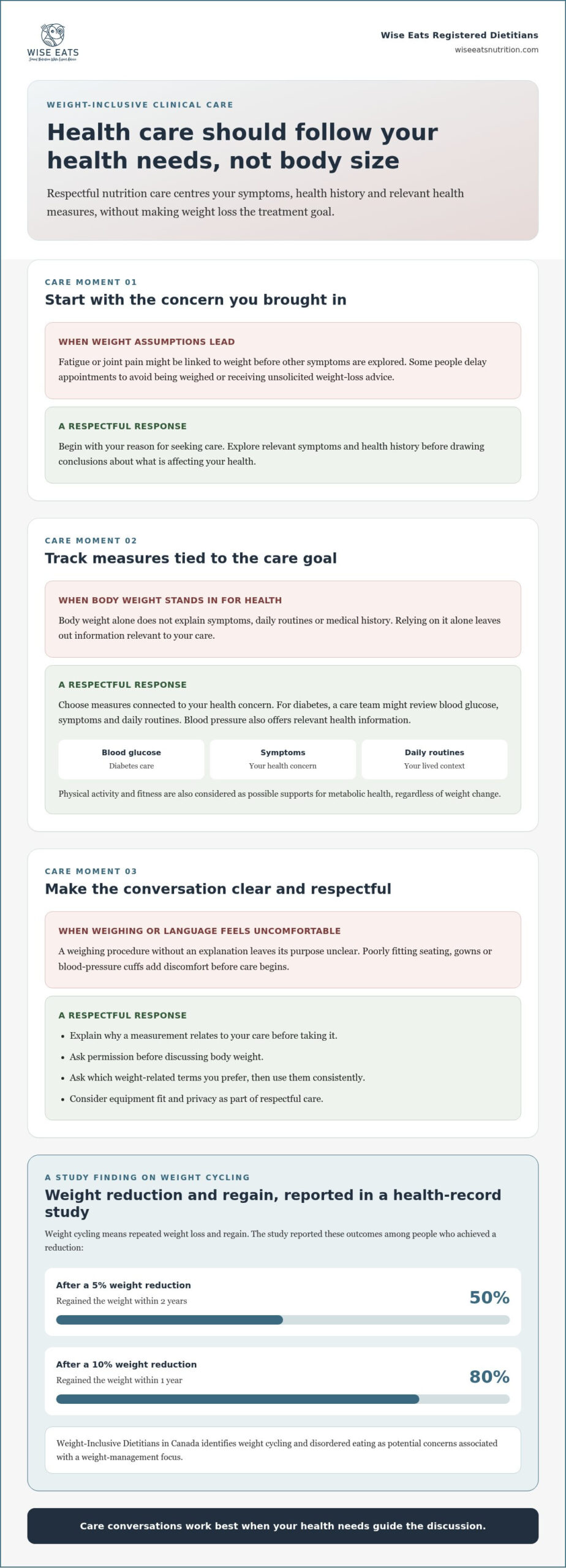
Weight stigma means unfair treatment or assumptions based on a person’s body size. In a clinic, a provider might attribute fatigue or joint pain to weight before asking about other symptoms. Some people delay appointments to avoid being weighed or receiving unsolicited weight-loss advice. Respectful care starts with the concern that brought you in. Before taking a measurement, the provider explains the procedure and why it may be relevant.
Health monitoring without weight measurements
Weight-inclusive care monitors measures relevant to a person’s health concern instead of relying on body weight alone. For diabetes, a care team might review blood glucose, symptoms and daily routines. Blood pressure can also provide relevant health information. Physical activity and fitness may support metabolic health, regardless of weight change. Connecting each measure to a specific care goal helps you understand what follow-up is assessing.
Weight cycling and potential harms
Weight cycling describes repeated weight loss and regain. A health-record study found that 50% of people who achieved a 5% weight reduction regained it within 2 years. In the same study, 80% of people who achieved a 10% reduction regained the weight within 1 year. Weight-Inclusive Dietitians in Canada identifies weight cycling and disordered eating as potential concerns associated with weight-management focus.
Public health rationale for weight inclusion
Weight-inclusive public health promotes health-supporting behaviours and access to resources across body sizes. The Ontario Dietitians in Public Health position statement cautions that framing obesity as a chronic disease can make weight loss the primary focus of care. It also argues that describing larger bodies as diseased pathologizes body size and presents body change as a cure. This approach asks care teams to consider health needs rather than make assumptions based on appearance.
Clinical nutrition care still addresses diagnosed conditions and symptoms. When assessing diabetes, for example, a provider considers blood glucose and the person’s health history. A dietitian might also ask about eating patterns or a notable change in weight as part of the assessment. These conversations can help identify concerns without treating body size as a diagnosis. The focus stays on the person’s needs and relevant clinical information.
Respectful care and weight stigma
Respectful care treats you as a person with individual health needs, not as a body size or a number. Weight stigma can affect how people experience nutrition advice, appointments and follow-up care.
Weight stigma and potential harms
Weight stigma includes stereotypes, unfair treatment or blame directed at someone because of their body weight. In health care, a clinician might attribute knee pain or fatigue to weight before exploring other possible causes. This can leave concerns unaddressed and undermine trust. A respectful visit starts with your reason for seeking care, then considers relevant symptoms and health history.
Body diversity and stigma
Body diversity means people naturally have different shapes and sizes, even when their eating and activity behaviours are similar. Stigma grows when one body type is treated as the standard for health. A person’s body size alone, for example, does not explain their food access, medication use, sleep or medical history. Inclusive care considers these details instead of assuming weight reflects personal choices.
Language around weight
The words used to discuss weight can shape whether a conversation feels respectful. A systematic review found that people generally prefer neutral weight-related terms, while “obese” and “fat” ranked among the least acceptable. Preferences vary between individuals and groups. A clinician can ask which terms you prefer, use them consistently and explain why weight is relevant to a particular health discussion.
Discrimination can also show up in practical details. A clinic’s seating, gowns or blood-pressure cuffs might not fit every patient, causing discomfort before care begins. A respectful team considers equipment and privacy, explains weighing procedures, and asks permission before discussing body weight. You can share your preferences about weighing and ask how a measurement relates to your care.
Research and patient experiences point to barriers that extend beyond a single appointment. If past comments about eating or body size have made you hesitant to seek care, explain what would help you feel respected. You might ask the clinician to focus first on your digestive symptoms or to explain the purpose of each question. Clear explanations support shared decisions.
Inclusive care also recognizes that food choices reflect culture, finances, access and family routines. Canada’s Food Guide does not represent every cultural group’s food choices, so familiar traditional foods should not be judged by whether they appear in the guide. A nutrition conversation can explore how your usual meals support your needs, then discuss practical additions or adjustments. For respectful, individualized nutrition support, book a nutrition counselling appointment.
Nutrition and medical care without weight-based assumptions
Weight-inclusive care addresses clinical nutrition needs without requiring weight loss as a treatment goal. People often ask how weight-inclusive and traditional weight-management nutrition counselling differ. The distinction affects the goals a dietitian sets and the signs used to assess progress.
Weight-inclusive and conventional care
Weight-inclusive care centres a person’s health needs and behaviours, while conventional weight-management care often centres weight reduction. A common question is, “What’s the difference between weight-inclusive and traditional weight-management nutrition counselling?” In practice, it often comes down to which outcomes guide appointments and follow-up.
For example, someone seeking support for elevated cholesterol might discuss food choices, access to meals and relevant health markers. A weight-centred plan might also track weight change as a primary outcome. Either way, care needs to consider the medical concern, symptoms and personal circumstances. These details help shape nutrition goals around the person’s actual needs.
HAES-based care and weight-loss programs
Health at Every Size (HAES)-based care supports wellbeing and health behaviours across body sizes. Weight-loss programs, by contrast, make weight reduction a central outcome. A comparison involving women aged 30 to 45 reported findings at the 1-year and 2-year follow-ups. Participants attended weekly group sessions for 6 months, followed by monthly group support for 6 months.
At follow-up, dropout was 41% in the diet group and 8% in the HAES group. These results describe one program comparison, not every counselling experience. A review of six randomized controlled trials assessed HAES-based interventions. Reported outcomes linked with non-diet approaches include reduced body dissatisfaction, disordered eating and depression. Study design and participants matter when interpreting results.
Weight-inclusive and weight-neutral approaches
Weight-neutral care does not aim to change body weight, and it does not reliably result in weight change. Weight-inclusive care also avoids weight as the main goal while actively supporting health behaviours and respectful treatment. The terms overlap, but weight-inclusive care places added emphasis on the conditions and supports that affect a person’s wellbeing.
In practice, a dietitian might discuss meal timing for diabetes or explore eating patterns related to digestive symptoms. Recommendations can account for cultural foods, daily schedules and medical needs. These goals remain relevant even if weight does not change. Weight-inclusive care is still clinical: progress is tied to the health concern and the person’s priorities, not a required number on the scale.
The Non-Diet Approach in nutrition counselling
The Non-Diet Approach shifts attention from weight targets to eating habits, wellbeing and individual needs. It encourages dietitians to question assumptions about body size and health, then build care around a person’s daily life.
In Canada, nutrition-counselling coverage depends on the province or territory, public program and extended health plan. Plan terms determine eligibility, referral requirements and reimbursement, so there is no single typical out-of-pocket cost. Review your plan’s dietitian coverage and any requirements before booking.
A weight-centric approach often treats weight loss as the main result of nutrition counselling. A weight-inclusive approach supports health-promoting behaviours without requiring body weight to change. For example, someone managing digestive symptoms might track when discomfort occurs, discuss meal patterns and choose changes that suit their routine. Their body size does not determine whether those concerns deserve care.
Critical approaches to dietetics ask how professional advice reflects culture, access and personal experience. Nutrition research and practice can prioritize Westernized foods and eating habits while overlooking traditional diets and other ways of knowing. A practical conversation might begin with the meals you already eat, your food budget and your family’s preferences. A dietitian can then discuss changes that support your nutrition needs without treating familiar foods as a problem.
Fiona Willer and clinical psychologist Louise Adams developed The Non-Diet Approach Guidebook for Psychologists and Counsellors in 2014. The guide’s approach encourages flexible eating and attention to hunger and fullness cues. For instance, a person might notice whether a meal feels satisfying and adjust the next meal based on comfort, schedule or appetite. These cues offer information, not rules every person must follow.
Weight-inclusive care also considers movement in relation to enjoyment and ability. A person with joint pain might discuss activities they find comfortable instead of receiving exercise advice tied to weight loss. Health care should account for conditions and daily limitations. A clinician can also discuss emotional eating without labelling food as a failure or assuming one eating pattern explains every concern.
For dietitians, this approach means examining the language and goals used in each appointment. A weight-loss target, for example, may not address someone’s stated concern about energy, meal access or distress around food. Asking what matters to the person helps shape useful goals. It also leaves room to coordinate with other members of the care team when nutrition needs overlap with medical or mental-health support.
Weight-inclusive nutrition counselling
Weight-inclusive counselling sets goals around health and daily life instead of requiring you to lose weight. A dietitian might ask which eating changes feel useful, which foods suit your culture and what routines fit your schedule. Your body size does not determine whether your nutrition concerns deserve attention.
Sessions often start with your priorities. You might want steadier energy during work shifts, fewer digestive symptoms or meals that feel satisfying. A dietitian can help identify a practical change, such as having a snack before a long shift or pairing familiar foods with a source of protein. Follow-up focuses on whether the change suits your needs and routine.
Hunger and fullness cues can help you notice your body’s signals. You might feel hungry before lunch or comfortably full after a meal. Medication, stress, illness, work schedules and food access can also affect appetite. A dietitian can explore these influences with you instead of treating appetite as a test you need to pass.
Food choices also reflect culture and social conditions. A meal plan should account for budget, cooking equipment, family meals and access to ingredients. Someone who relies on community meals needs advice suited to those options, not a list built around unavailable foods. Adding a familiar fruit, grain or protein source may fit better than replacing entire meals.
Movement belongs in the conversation when it supports wellbeing and suits your abilities. Someone with chronic pain might prefer gentle stretching or short walks, while another person enjoys dancing. Health conditions and personal preferences shape suitable options. The aim is to find accessible movement, not to prescribe activity as a way to change weight.
Weight-inclusive care still addresses disease and nutrition-related concerns. For diabetes, counselling might cover meal timing and carbohydrate choices alongside your care team’s treatment plan. For elevated cholesterol, sessions might explore fibre-rich foods that suit your meals and budget. The focus stays on the health concern instead of assuming weight loss must come first.
When to Seek Help
Some eating-related changes call for additional support. Consider talking with your care team if you notice:
- You’re eating less or avoiding more foods over time, and meals feel increasingly stressful.
- Episodes of eating feel out of control or lead you to hide from people close to you.
- You’re vomiting, using laxatives to compensate for eating, or experiencing fainting or ongoing weakness.
These signs do not define you. A health professional can help you discuss what’s happening and consider support that suits your needs.
Progress might include eating regular meals, adding nourishing foods or finding satisfying options on busy days. A change in weight is not required to recognize that progress. If food rules or distress around eating affect your daily life, discuss your concerns with a health professional. Nutrition care should take your goals and relationship with food into account.
Wise Eats Registered Dietitians: Custom Meal Planning
Wise Eats Registered Dietitians offers Custom Meal Planning for people who want nutrition support tailored to their health needs, food preferences and daily routines. A plan can help organize meals around a health concern, cultural foods or a busy schedule without making weight change the measure of success.
Wise Eats also offers Weight Management and an Eating Disorder Recovery Program. If food choices feel stressful or you want help building a more flexible approach to eating, a Registered Dietitian can work with you on practical nutrition goals. Personalized Vitamin and Mineral Supplements are also available for people seeking guidance about their supplement needs.
To discuss nutrition support suited to your goals, contact Wise Eats Registered Dietitians.
Choose nutrition support that fits your needs
Understanding the difference between weight-inclusive and traditional weight-management nutrition counselling starts with considering what you want care to support: a medical concern, challenging eating patterns or goals shaped by daily life. Before an appointment, write down the concern you want addressed and what respectful support looks like to you. You might note your preferred language about body weight, questions about food routines or concerns about weight entering the conversation. Sharing these priorities gives you a clear starting point and helps keep the discussion centred on your needs.
You deserve care where questions are welcomed and next steps are discussed with you. If you’re unsure how to begin, choose one concern to raise. A Registered Dietitian can work alongside your broader care team on nutrition goals shaped by your situation and preferences. You can also ask how your goals will guide future conversations, so your care plan remains relevant as your needs change.
Taking this step helps make your priorities part of the conversation.
Frequently Asked Questions
How do I start shifting my practice to a more weight-inclusive approach?
Start by reviewing your forms, language and routine appointment steps. Replace weight-focused intake questions with prompts about a person’s goals, symptoms, food access and past care experiences. Ask permission before weighing and explain the clinical reason when a measurement is relevant. For example, invite patients to share their preferred terms for discussing body size. Regular reflection and learning can help dietitians notice assumptions and adjust their care.
How does weight-inclusive care translate into nutrition counselling?
In a counselling session, the dietitian and client agree on a nutrition goal tied to a specific need. Someone with a tight grocery budget might plan filling meals using familiar, affordable ingredients. A person with a new diagnosis might discuss food routines alongside their medical care plan. Follow-up can focus on whether the agreed change suits the person’s schedule, access and preferences, then adjust the plan together.
If I’m not measuring weight, what should I track?
Choose measures connected to your health goal. For diabetes, blood glucose readings and symptoms can provide relevant information. For digestive concerns, note symptom patterns and how they relate to meals or routines. You might also track energy, mood, sleep or ease with daily activities. Select measures with your care team and review them over time. A single measure rarely explains every change in health or wellbeing.
Does a higher body weight lead to health problems?
Higher body weight alone does not show whether someone has a health problem. Health is shaped by factors such as genetics, environment, access to care and social conditions. Clinicians assess symptoms and relevant health markers instead of assuming a condition based on body size. Fatigue, for example, deserves assessment whether someone has a smaller or larger body.
What’s missing from the “prescribe a weight loss amount” conversation?
A weight-loss target alone leaves out a person’s priorities, treatment choices and the possible effects of a plan. Before discussing an intervention, clinicians should explain limits in the research, potential physical and psychological risks, and other care goals. A useful conversation also considers food access, medications, health history and the person’s relationship with eating. Ask what success would look like if your weight stayed the same.
What is weight-inclusive nutrition counselling?
Weight-inclusive nutrition counselling supports health and wellbeing without making weight change a required outcome. A dietitian might help someone plan meals around a medical need, culture and work schedule. The person and dietitian agree on goals, then review how those steps fit daily life. This approach does not promise a particular weight outcome or replace medical care for a health condition.
What is traditional weight-management nutrition counselling?
Traditional weight-management counselling generally makes weight reduction a central goal. A program might set a weight target, suggest planned changes to eating or activity, and track weight over time. Some programs also offer group sessions or follow-up support. Ask how the plan addresses your medical needs, daily circumstances and emotional wellbeing, rather than judging its fit by a target number alone.
How do weight-inclusive and traditional approaches differ in goals and measures of success?
The main difference is the outcome each approach prioritizes. Traditional weight-management counselling often assesses progress through weight change. Weight-inclusive care sets goals around health needs and supportive behaviours, such as following a meal routine that works during shift work. Before starting counselling, ask how progress will be reviewed and whether the plan keeps your health priorities at its centre.
Article by
Rachel McBryan, Dietitian
Rachel McBryan is a licenced Dietitian in British Columbia offering comprehensive nutrition counselling as virtual and/or in-person counselling sessions to suit your needs and preferences. With a Bachelor of Science in Nutrition and Food Science, Rachel has over 20 years experience helping people address their health through nutrition. She was awarded Human Nutrition and Food Science BSc.from University of Alberta followed by post-grad course work at UBC in guidance counselling.
An eating disorder is a serious mental health illness.
If you are in immediate distress or crisis, please contact emergency services by dialing 911 or calling Vancouver Island Crisis Line: 1-888-494-3888.