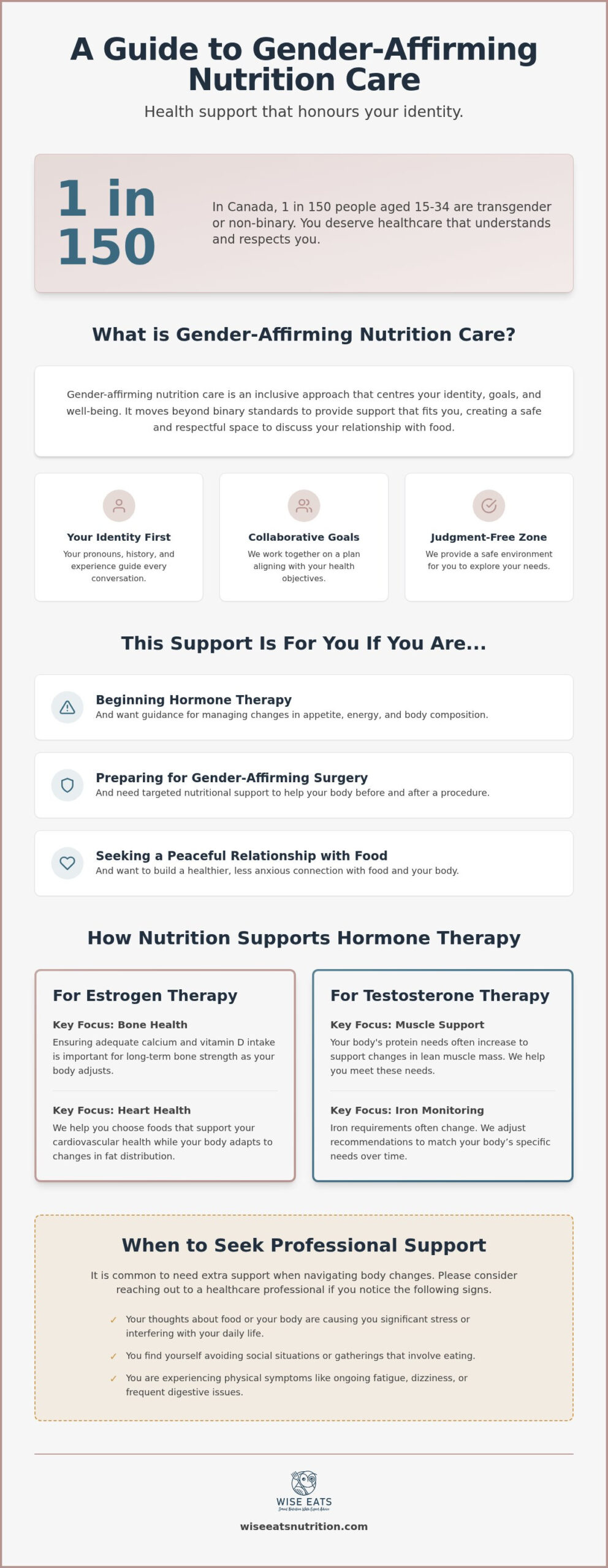
One in every 150 Canadians between ages 15 and 34 identifies as transgender or non-binary. Finding healthcare providers who respect your identity often feels difficult. You deserve a clinical setting built on respect for your pronouns and gender goals. It is common to feel unsure about how hormone replacement therapy affects your appetite, energy, or long-term heart health. Anxiety regarding food choices or body shape changes often increases the stress of your transition.
Understanding gender-affirming nutrition counselling: what clients can expect involves more than simple meal plans or rigid rules. This article explains how inclusive nutrition care supports your transition in Alberta or British Columbia. You will find details on managing hormone-related changes, ways to discuss your relationship with food without fear of judgment, and what happens during a professional consultation. Our goal is to provide a plan for your first appointment so you feel prepared, heard, and hopeful about your health.
Key Takeaways
- Gender-affirming nutrition care prioritizes your identity and health goals over binary standards.
- Hormone therapy influences muscle mass and fat distribution, making expert guidance helpful for supporting your body through these changes.
- Learn about gender-affirming nutrition counselling: what clients can expect during a first visit focused on your unique history and needs.
- Identify signs of disordered eating used to manage gender dysphoria and learn how to build a peaceful relationship with food.
- Virtual appointments provide residents in Calgary, Edmonton, and Vancouver Island access to dietitians who specialize in inclusive care.
Defining Gender-Affirming Nutrition Care
Gender-affirming nutrition care is a clinical approach that places your identity, your goals, and your comfort at the centre of every session. It draws from the broader field of Transgender health care, which recognizes that effective support requires understanding the whole person, not just a set of physical symptoms. A Registered Dietitian working within this model uses evidence-informed guidance to help you build eating habits that support your body through transition, without imposing rigid rules or binary assumptions about how you should look or eat.
This video from Dietitians in Nutrition Support offers a practical look at what a nutrition assessment involves for transgender and gender diverse clients, including what to expect from both the conversation and the clinical process:
The Purpose of Inclusive Nutrition
Healthcare settings are not always designed with transgender or non-binary people in mind. That gap creates real stress, and stress affects how you eat, how you sleep, and how your body responds to treatment. Inclusive nutrition care reduces that burden by creating a space where your pronouns are respected, your history is heard, and your goals shape the plan.
A Registered Dietitian in this space helps you align your food choices with your identity rather than with outdated clinical charts built around binary categories. When your care team understands your full picture, long-term health outcomes improve. That connection between feeling safe and eating well is not incidental. It’s central to the work.
Who Benefits from These Services
Gender-affirming nutrition counselling, and what clients can expect from it, applies across a wide range of situations. You don’t need to be at a specific stage of transition to benefit. People who find this support most helpful include:
- Those beginning hormone therapy, who want guidance on managing changes to appetite, energy, and body composition
- Individuals preparing for gender-affirming surgery, who need targeted nutritional support before and after a procedure
- Anyone wanting a more peaceful relationship with food, free from diet-culture pressure or the anxiety that often accompanies body changes
At Wise Eats, Rachel McBryan, RD (registered with the College of Health and Care Professionals of BC) and Sheirry Poposka, RD (registered with the Alberta College of Registered Dietitians) offer virtual appointments for clients in Calgary, Edmonton, Nanaimo, Parksville, and across both provinces. Understanding gender-affirming nutrition counselling and what clients can expect starts with knowing that your first session is built around you, not a template.
Supporting Your Body During Hormone Therapy
Hormone therapy reshapes how your body uses food at a fundamental level. The shift isn’t subtle. Estrogen and testosterone influence where your body stores fat, how efficiently it builds muscle, and how it absorbs key nutrients. Knowing what to expect from these changes makes it easier to eat in a way that supports your body rather than working against it.
Research on nutritional requirements for people on hormone therapy confirms that energy needs, protein targets, and micronutrient priorities all shift once hormone therapy begins. A Registered Dietitian uses this evidence to build a personalized meal plan that reflects where you are in your transition, not a generic template designed for someone else’s body. This is a central part of gender-affirming nutrition counselling and what clients can expect from a qualified professional.
Nutritional Needs for Estrogen Therapy
Estrogen therapy influences bone density over time, which makes skeletal health a priority from the start. Adequate calcium and vitamin D intake supports bone strength during this process. Fat distribution also shifts, and lipid levels in the blood often change alongside those physical adjustments. A Registered Dietitian monitors these patterns and works with you to choose foods that protect your heart health long-term, without labelling any food as off-limits. The focus stays on building a sustainable, nourishing routine you feel good about.
Nutritional Needs for Testosterone Therapy
Testosterone therapy frequently increases lean muscle mass, and your body’s demand for protein rises alongside that change. Getting enough protein from a variety of food sources helps support those physical shifts without requiring a rigid or restrictive approach to eating. Iron is another nutrient worth tracking, particularly if your menstrual cycle has changed or stopped, since iron needs vary depending on those factors. Your Registered Dietitian reviews your full picture and adjusts recommendations as your body responds to therapy over time.
Changes in appetite and energy levels are also common during hormone therapy, and they don’t follow a predictable schedule. Some people feel hungrier than usual in the early months. Others notice fatigue that affects their motivation to cook or eat regularly. A custom meal plan accounts for these fluctuations so your nutrition stays consistent even when your energy doesn’t.
If you’re in Calgary, Nanaimo, Parksville, or anywhere across Alberta or BC, virtual appointments make it straightforward to get this level of personalized support. Book a session with a Wise Eats dietitian to start building a plan that moves with your body, not against it.
When to Seek Help for Disordered Eating
Gender-diverse individuals face unique pressures regarding body image. Society often imposes strict ideas about how a person looks based on their identity. These expectations create stress. In some cases, people use food restriction to manage gender dysphoria. This happens when someone tries to change their body shape or suppress certain physical traits through eating habits. These actions often start as a way to feel safer in your body. However, they lead to a difficult relationship with food.
Professional support helps you move toward food neutrality. This means seeing food as fuel and pleasure rather than a source of shame or a tool for control. Compassionate care is available for your recovery journey. Understanding gender-affirming nutrition counselling: what clients can expect includes having a safe space to discuss these struggles without judgment.
When to Seek Help
It is important to know when your relationship with food requires professional attention. If you notice these red flags, reach out to your care team for support:
- Restrictive eating habits: Skipping meals, avoiding entire groups of food, or eating small portions to change your body shape.
- Binge eating or compensatory behaviours: Feeling out of control while eating or using exercise and other methods to make up for food choices.
- Physical symptoms: Constant fatigue, feeling cold often, or frequent dizziness signal nutritional gaps.
Moving Toward Food Freedom
A dietitian works with your healthcare team to support your eating disorder recovery. Recovery is a collaborative process. Evidence-based strategies help you rebuild your relationship with food by focusing on your needs rather than outside pressures. Inclusive meal plans avoid restrictive language and focus on adding nourishment to your life. This approach helps you align your eating habits with your identity sustainably.
Gender-affirming nutrition counselling: what clients can expect involves more than a list of foods. It provides a framework for understanding how your identity influences your choices. Your dietitian listens to your experiences and helps you find a path toward food freedom. This journey prioritizes your well-being and respects your transition goals at every step. Having a professional partner makes the process feel manageable and supportive.
Steps in Your First Nutrition Consultation
Walking into any new healthcare appointment brings a mix of hope and uncertainty. Your first session with a Registered Dietitian at Wise Eats is structured to ease that uncertainty from the moment you log on. There’s no intake form that assumes your gender, no chart that measures you against a binary standard, and no pressure to arrive with all the answers. You bring your story. Your dietitian brings the clinical tools to help you move forward.
The Initial Assessment Phase
The first part of your appointment focuses on gathering a clear picture of where you are right now. Your dietitian asks about your medical history, current medications, and any supplements you’re taking. If you’re on hormone therapy, that information shapes the nutrient priorities your dietitian identifies for your plan. You’re also invited to share your gender journey and transition goals at whatever level of detail feels comfortable to you. Nothing you share is treated as incidental. All of it informs the clinical decisions your dietitian makes on your behalf.
This is a core part of gender-affirming nutrition counselling and what clients can expect: a conversation that listens before it advises. Your dietitian identifies specific nutrient requirements based on your full picture, not a generalized profile.
Building Your Personalized Plan
Once your dietitian understands your history and goals, the planning phase begins. Wise Eats uses EatLove, a flexible meal planning tool, to build options that fit your schedule, food preferences, and budget. The plan adapts to your life rather than demanding your life adapt to it.
Where nutritional gaps exist, custom vitamin and mineral recommendations fill them in. Wise Eats works with VitaminLab to create personalized supplement formulas based on your specific needs. You leave your first session with clear, actionable next steps and a plan written for your body at this stage of your transition.
Follow-up sessions are where the plan gets refined. Your body’s response to hormone therapy shifts over time, and your nutrition support shifts with it. If something isn’t working, your dietitian adjusts the approach. The goal is a plan you can actually live with, not one you abandon after two weeks.
Residents in Calgary, Edmonton, Nanaimo, Parksville, and across Alberta and BC access these sessions virtually through a secure online platform. You get the same level of personalized care regardless of where you live. To learn more about what working with a Registered Dietitian looks like, visit the Wise Eats working with a dietitian page.
Accessing Inclusive Care in Alberta and British Columbia
Finding inclusive care in Western Canada requires clear information about provincial regulations. Wise Eats provides support across Alberta and British Columbia. Residents in Calgary, Edmonton, or Vancouver Island find professional help available. Our team follows the strict standards of their provincial colleges to ensure you receive safe, evidence-informed care.
Provincial health plans in Alberta and British Columbia cover some surgeries. These plans do not include private dietitian fees. Many workplace insurance plans offer coverage for services from a Registered Dietitian. This makes inclusive nutrition care accessible for many individuals. Gender-affirming nutrition counselling: what clients can expect involves working with a professional who understands these provincial systems.
The College of Health and Care Professionals of British Columbia launched a new policy on gender diversity in late 2024. This policy encourages health professionals to provide affirming and culturally safe care. Rachel McBryan, RD, follows these provincial guidelines in her practice. In Alberta, Sheirry Poposka, RD, adheres to the standards set by the Alberta College of Registered Dietitians. These regulatory bodies ensure your dietitian provides evidence-informed support. Working with a locally registered professional means your care aligns with current provincial health standards.
Meet Your Registered Dietitians
The Wise Eats team consists of professionals dedicated to gender-affirming care. Rachel McBryan, RD, belongs to the College of Health and Care Professionals of BC. Sheirry Poposka, RD, belongs to the Alberta College of Registered Dietitians. These professional titles guarantee your provider meets rigorous educational and ethical requirements. Our team brings years of clinical nutrition experience to your transition journey.
Rachel focuses on clients in British Columbia, including those in Nanaimo and Parksville. Sheirry supports residents across Alberta, from Calgary to Edmonton. Having a dietitian registered in your own province ensures they follow specific laws and health guidelines governing your area. This local expertise provides peace of mind during your transition. We understand the healthcare environment in both provinces and stay updated on changing regulations.
Booking Your Virtual Session
Online appointments provide a safe and private environment for your consultation. You join the session from your home. Virtual care removes the barrier of travel. It allows you to discuss your needs in a space you feel secure. Direct billing options exist for some insurance plans. This simplifies the process of getting help.
Your dietitian listens to your experiences without judgment. Every session focuses on your comfort and your health goals. Professional support is a click away for Western Canadians. Whether you need help with hormone-related changes or disordered eating recovery, our team is ready to help. You deserve care that respects your identity and supports your long-term wellness.
Start Your Journey Toward Food Neutrality
Transitioning involves many moving parts. Nutrition provides a foundation for feeling strong and aligned with your identity. You now have a clearer picture of gender-affirming nutrition counselling: what clients can expect during your journey. Professional support helps you manage hormone-related shifts and build a peaceful relationship with food. Choosing a dietitian who understands the specific needs of the transgender community makes a difference in your long-term wellness. This inclusive approach focuses on your comfort and your personal health goals.
Rachel McBryan, RD, with the College of Health and Care Professionals of BC, and Sheirry Poposka, RD, with the Alberta College of Registered Dietitians, provide this specialized care. They offer virtual sessions for residents in Calgary, Edmonton, Nanaimo, and Parksville. Their expertise ensures your plan follows provincial health standards while prioritizing your safety. Expert guidance replaces confusion with a steady path toward your goals. You deserve a partner who respects your pronouns and your history.
Your health goals deserve a space free from judgment. We are here to help you move forward with clarity and hope. Taking this step supports your body and your peace of mind.
Frequently Asked Questions
Will my dietitian understand my gender identity?
Yes. At Wise Eats, your pronouns are respected from the first appointment. Rachel McBryan, RD, College of Health and Care Professionals of BC, and Sheirry Poposka, RD, Alberta College of Registered Dietitians, both work within an affirming clinical framework. Your gender history informs your care plan rather than being treated as a side note. You won’t be measured against binary standards or asked to justify your identity before receiving support.
Do I need a doctor referral for gender-affirming nutrition counselling?
No referral is required to book a session with a Wise Eats Registered Dietitian. You contact the practice directly and schedule a virtual appointment through their online booking system. That said, sharing information from your prescribing physician or gender-affirming care team helps your dietitian build a more complete picture of your nutrient priorities, particularly if you’re currently on hormone therapy or preparing for a procedure.
How do hormones affect my daily calorie needs?
Hormone therapy shifts how your body uses energy, stores fat, and builds muscle, so your calorie needs don’t stay static. Testosterone therapy often increases lean muscle mass, which raises your protein requirements. Estrogen therapy changes fat distribution and influences lipid levels. These shifts happen gradually and vary from person to person. A Registered Dietitian reviews your full picture and adjusts your meal plan as your body responds to treatment over time.
Will a dietitian help me prepare for gender-affirming surgery?
Nutritional support before and after gender-affirming surgery is part of what gender-affirming nutrition counselling covers, and it’s something clients can expect to discuss during their consultation. Your dietitian works with your surgical care team to identify nutrient priorities that support healing. Protein intake, micronutrient levels, and overall energy adequacy all play a role in surgical recovery. Your plan is built around your specific procedure and timeline, not a generic pre-operative template.
Is virtual nutrition counselling as effective as in-person visits?
Virtual appointments deliver the same level of personalized clinical care as in-person sessions. Wise Eats uses a secure online platform so clients in Calgary, Edmonton, Nanaimo, Parksville, and across Vancouver Island receive consistent, evidence-informed support regardless of where they live. Many clients find virtual sessions easier to attend regularly, which supports better long-term outcomes. The session format, including your assessment, meal planning, and supplement review, remains the same.
How long will I need to work with a dietitian?
The length of time varies based on your goals, your stage of transition, and how your body responds to hormone therapy. Some clients find a few focused sessions address their immediate questions. Others benefit from ongoing support as their nutritional needs shift over months or years. Your Wise Eats dietitian reviews your progress at each follow-up and adjusts your plan accordingly. There’s no fixed timeline imposed on you from the start.
Are these services covered by Canadian health insurance?
Provincial health plans in Alberta and British Columbia do not cover private dietitian fees. Many workplace extended health benefits plans include coverage for Registered Dietitian services, so it’s worth reviewing your policy or contacting your benefits provider directly. When your dietitian holds registration with a recognized provincial college, such as the College of Health and Care Professionals of BC or the Alberta College of Registered Dietitians, your claim is more likely to be accepted by your insurer.
How do I know if my dietitian is gender-affirming?
A gender-affirming dietitian asks for your pronouns at the start of your first session and uses them consistently. They don’t assume your dietary needs based on your sex assigned at birth, and they don’t require you to explain or defend your identity before receiving care. Checking that your provider holds registration with a recognized provincial college is a practical starting point. Speaking with a registered dietitian who has experience supporting transgender and gender-diverse clients gives you a clearer sense of their approach before you commit to ongoing sessions.
Article by
Rachel McBryan, Dietitian
Rachel McBryan is a licenced Dietitian in British Columbia offering comprehensive nutrition counselling as virtual and/or in-person counselling sessions to suit your needs and preferences. With a Bachelor of Science in Nutrition and Food Science, Rachel has over 20 years experience helping people address their health through nutrition. She was awarded Human Nutrition and Food Science BSc.from University of Alberta followed by post-grad course work at UBC in guidance counselling.
An eating disorder is a serious mental health illness.
If you are in immediate distress or crisis, please contact emergency services by dialing 911 or calling Vancouver Island Crisis Line: 1-888-494-3888.