Mandatory Disclaimer: This article is for general educational purposes and is not a substitute for individualized medical or nutrition advice. Please speak with a physician or Registered Dietitian for guidance tailored to your specific needs.
You’ve probably seen the lists online: vibrant fruits and vegetables labelled “alkaline,” while grains, dairy, and meat are branded as “acid-forming.” The alkaline diet promises that by carefully managing your body’s pH through food, you can prevent serious diseases like cancer and osteoporosis, boost your energy, and lose weight.
It’s an appealing idea. But in a world full of conflicting health information, it’s natural to ask: Is there any high-quality scientific evidence to back these claims up? Or is this just another food myth?
This article is a systematic review of the evidence. We will look directly at the highest level of scientific research to separate fact from fiction, so you can make informed decisions about your health with clarity and confidence.
Understanding the Alkaline Diet: The "Acid-Ash" Hypothesis Explained
The core idea behind the alkaline diet is the “acid-ash hypothesis.” This theory suggests that when your body metabolizes food, it leaves behind a metabolic waste or “ash.” This ash can be either acidic or alkaline, depending on the food you ate.
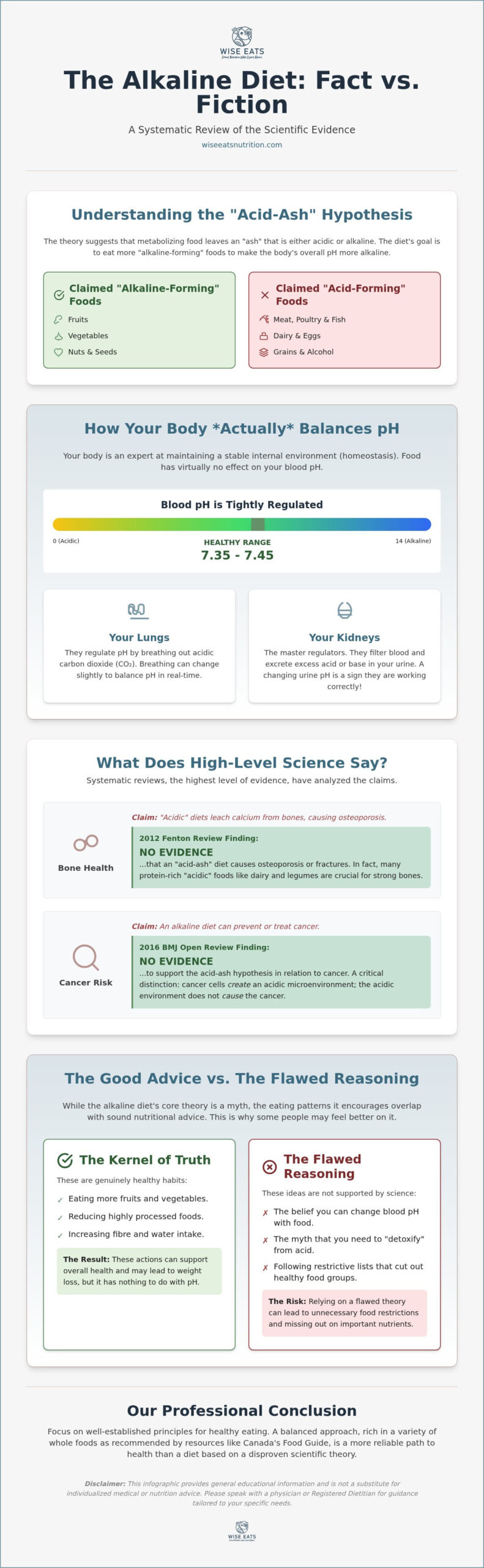
- The diet categorizes foods based on the pH of their "ash." Fruits, vegetables, and some nuts are considered "alkaline-forming."
- Meat, poultry, fish, dairy, eggs, grains, and alcohol are considered "acid-forming."
- The goal is to consume more alkaline-forming foods to shift your body’s overall pH into a more alkaline state, which proponents claim is healthier.
To understand this, we need to quickly look at the pH scale. It runs from 0 (highly acidic) to 14 (highly alkaline), with 7 being neutral. Proponents of the diet often encourage testing urine pH to see if the diet is "working." However, it’s crucial to understand the difference between urine pH and blood pH—a distinction where the entire theory begins to unravel.
The Core Theory: Why People Believe It Works
The central claim is that the typical modern diet is too high in acid-forming foods. This, according to the theory, creates an acidic internal environment that promotes chronic inflammation and disease. The diet’s appeal is understandable; it offers a sense of control and a simple formula for health: eat more “alkaline” foods like fruits and vegetables.
And here lies a kernel of truth: encouraging a high intake of plant foods is excellent advice. However, the reasoning behind why this is beneficial is where the alkaline diet deviates from established science.
The Biology of pH Balance: How Your Body Actually Works
The human body is an expert at maintaining balance, a process called homeostasis. Your blood pH is one of the most tightly regulated systems you have. For you to survive, your blood must remain within a very narrow range of 7.35 to 7.45.
If your blood pH were to stray outside this range, you would become critically ill. Thankfully, your body has powerful, built-in mechanisms to prevent this from happening:
- Your Lungs: You breathe out carbon dioxide (an acid) with every breath. If your blood becomes slightly too acidic, your breathing rate can increase to expel more C02.
- Your Kidneys: Your kidneys are the master regulators. They filter your blood and excrete excess acid or base in your urine. This is why your urine pH can change based on what you eat, but your blood pH does not.
In a healthy person, the food you eat cannot significantly change the pH of your blood. Your body’s regulatory systems are simply too effective. A changing urine pH only shows that your kidneys are doing their job correctly—not that you’ve successfully changed your body’s internal environment.
What Does the Science Say? A Systematic Review of the Evidence
When we want the most reliable answer to a health question, we look at systematic reviews. A systematic review is a type of research that gathers and analyzes all the available studies on a specific topic. It’s considered one of the highest levels of evidence. So, what do these high-quality reviews say about the alkaline diet?
The consensus is clear: the proposed mechanism of the alkaline diet is flawed. While the food choices it encourages are often healthy, there is no evidence that they work by changing your blood pH.
The 2012 Fenton Review: Bone Health and Calcium
One of the most common claims is that "acidic" foods leach calcium from your bones, leading to osteoporosis. To investigate this, a comprehensive systematic review was published in the Journal of Bone and Mineral Research in 2012 by researchers Fenton, Tough, Lyon, and Hanley.
Their findings were definitive:
- The review found no evidence that an "acid-ash" diet causes osteoporosis or bone fractures.
- They noted that while urine calcium levels can increase after eating certain foods, this is not a reliable marker for bone loss.
- Ironically, many protein-rich foods labelled "acidic" (like dairy and legumes) are actually essential for building and maintaining strong bones. Avoiding them could do more harm than good.
The 2016 BMJ Open Review: The Cancer Connection
Perhaps the most dangerous claim is that the alkaline diet can prevent or even treat cancer. A systematic review published in BMJ Open in 2016 searched through thousands of studies to find evidence for this.
The conclusion was blunt: "There is no evidence to support the acid-ash hypothesis in relation to cancer."
The researchers found no studies showing that dietary acid or alkaline water could influence cancer risk or outcomes. It’s important to clarify a key point of confusion: cancer cells create an acidic microenvironment around themselves. The acidic environment does not cause the cancer. This is a critical distinction. Following an unproven diet in place of or alongside conventional medical treatment can have serious, life-threatening consequences.
Debunking Common Claims: Bone Health, Cancer, and Metabolism
With the core scientific mechanism debunked by high-level reviews, let’s address some of the other popular myths associated with the alkaline diet.
- Weight Loss: Can an alkaline diet help with weight loss? Yes, but not because of its effect on pH. The diet eliminates processed foods and emphasizes fruits and vegetables, which are high in fibre and water. This pattern can create a calorie deficit, leading to weight loss. Any balanced eating plan focused on whole foods can achieve the same result without the restrictive rules.
- "Detox" Myths: The idea that you need to "detoxify" your body from acid is a marketing myth. Your kidneys and liver are your body’s powerful, full-time detoxification system. They don’t need help from expensive water or supplements.
- Food Lists vs. Canadian Guidelines: When you compare the "Alkaline Food List" to Canada’s Food Guide, you’ll see overlap in the recommendation to eat plenty of fruits and vegetables. However, the alkaline diet unnecessarily restricts healthy food groups like whole grains, legumes, and dairy, which are cornerstones of a balanced diet according to Health Canada.
It’s important to recognize why these myths are so appealing, especially when facing a health scare. They offer a simple, actionable plan that provides a sense of control. However, true control comes from understanding the evidence and building sustainable habits, not from fearing entire food groups.
Does Alkaline Water Make a Difference?
What about the expensive "alkalized" or "ionized" water? Once alkaline water hits your stomach, it is immediately neutralized by your highly acidic stomach acid (which has a pH of 1.5-3.5). Your stomach needs this acidity to digest food and kill pathogens. There is no reliable scientific evidence that alkaline water provides any health benefits beyond the hydration you get from regular tap water. For more information, you can read about the health benefits of excellent hydration from any clean water source.
Muscle Mass and Kidney Function
There is one specific medical condition where managing dietary acid load is important: chronic kidney disease (CKD). In patients with failing kidneys, the body’s ability to excrete acid is impaired. In these cases, a Registered Dietitian may recommend a specialized diet to reduce the load on the kidneys.
This is a form of Medical Nutrition Therapy, prescribed and monitored by a healthcare professional. It is not a wellness trend for the general public. For healthy adults, your kidneys are more than capable of handling the acid load from a balanced diet.
The Hidden Risks of Strict Alkaline Eating Patterns
While encouraging more vegetables is positive, a strict adherence to the alkaline diet can introduce real health risks.
- Nutrient Deficiencies: Avoiding entire food groups like dairy, legumes, and whole grains can lead to inadequate intake of essential nutrients like calcium, Vitamin D, iron, zinc, and B vitamins.
- Muscle Loss: Many excellent protein sources (lean meat, fish, lentils, beans) are labelled "acidic." Avoiding them can make it difficult to get enough protein, which is critical for maintaining muscle mass, especially as we age. This can contribute to a condition called sarcopenia, or age-related muscle loss.
- Psychological Toll: Labelling foods as "acidic" or "toxic" can create unnecessary fear and anxiety around eating. This black-and-white thinking can damage your relationship with food and may contribute to disordered eating patterns like orthorexia—an unhealthy obsession with "healthy" eating.
When to Seek Help
Building a healthy relationship with food should bring you peace, not stress. If you find yourself feeling anxious about your food choices or spending an excessive amount of time planning "perfect" meals, it may be helpful to speak with a professional. Consider reaching out if:
- You feel intense guilt or anxiety after eating a food you’ve labelled as "bad" or "acidic."
- Your diet is interfering with your social life, causing you to avoid meals with friends or family.
- You are experiencing physical symptoms like fatigue or hair loss, which could indicate a nutrient deficiency.
A Registered Dietitian can help you move away from food fear and toward a more flexible, enjoyable, and truly nourishing way of eating. For those struggling with these thoughts, learning how to work with a dietitian for orthorexia recovery can be a vital step.
A Balanced Approach: How a Registered Dietitian Can Help You Find Clarity
So, we’ve established that the alkaline diet’s theory isn’t supported by science. What’s the alternative? The answer isn’t another restrictive diet. It’s a personalized, evidence-based approach developed with a qualified professional.
A Registered Dietitian is a regulated health professional trained to translate complex nutrition science into practical, real-life advice. We can help you filter through the hype and focus on what truly matters for your health.
- Focus on Adding, Not Subtracting: Instead of fearing "acidic" foods, a dietitian can help you focus on adding more nutrient-dense foods to your plate. A meal like our Hearty Lentil and Whole Grain Soup is a perfect example of combining so-called "acidic" foods into a powerfully nutritious meal.
- Personalized Plans: Your health needs are unique. A dietitian will create a custom meal plan that considers your goals, lifestyle, and food preferences, ensuring it’s both effective and sustainable.
- Evidence-Based Guidance: We rely on the same kind of high-quality systematic reviews discussed in this article to provide advice that is safe, effective, and free from pseudoscience.
You don’t have to navigate this confusing information alone. Working with a dietitian provides you with a clear, reliable path forward, empowering you to build a healthy eating pattern that lasts a lifetime.
Ready to move beyond the myths and find a balanced, evidence-based plan that works for you? Book a discovery call with a Registered Dietitian today.
Frequently Asked Questions (FAQs)
- Can the alkaline diet cure or prevent cancer?
No. A 2016 systematic review published in BMJ Open found no evidence that alkaline diets or alkaline water can prevent or treat cancer. It is critical to follow the advice of your oncology team for cancer treatment. - Is it true that acidic foods leach calcium from my bones?
No. A major 2012 systematic review concluded there is no evidence that the "acid-ash" from your diet causes osteoporosis. In fact, many protein-rich foods labelled "acidic" are vital for bone health. - What are the best "alkaline" foods I should actually keep in my diet?
The best foods promoted by the alkaline diet are simply healthy foods in general: fruits, vegetables, nuts, and seeds. You should absolutely keep these in your diet because they are packed with vitamins, minerals, and fibre—not because of their effect on pH. - Do I need to test my urine pH to see if my diet is working?
No, this is not a useful or meaningful test for your overall health. Your urine pH naturally fluctuates throughout the day. A change in its pH simply means your kidneys are working correctly to maintain your blood’s strict pH balance. - Is alkaline water better for hydration than regular tap water?
There is no reliable scientific evidence that alkaline water is better than regular tap water. Your stomach acid neutralizes it upon consumption. The most important thing is to stay well-hydrated with clean water from any source. - Can an alkaline diet help with weight loss?
It may, but only because it encourages eating more whole plant foods and cutting out processed items, which can lower your overall calorie intake. The weight loss has nothing to do with pH balance.
About the Authors
This article was written and reviewed by the team of expert dietitians at Wise Eats. Our goal is to provide clear, evidence-based nutrition information to help Canadians navigate their health with confidence.
Rachel McBryan, Dietitian (licenced) is a member of the College of Health and Care Professionals of BC.
Sheirry Poposka RD, Registered Dietitian is a member of the Alberta College of Registered Dietitians.

Article by
Rachel McBryan, Dietitian
Rachel McBryan is a licenced Dietitian in British Columbia offering comprehensive nutrition counselling as virtual and/or in-person counselling sessions to suit your needs and preferences. With a Bachelor of Science in Nutrition and Food Science, Rachel has over 20 years experience helping people address their health through nutrition. She was awarded Human Nutrition and Food Science BSc.from University of Alberta followed by post-grad course work at UBC in guidance counselling.
An eating disorder is a serious mental health illness.
If you are in immediate distress or crisis, please contact emergency services by dialing 911 or calling Vancouver Island Crisis Line: 1-888-494-3888.