Feeding Kids with Autism and sensory disorders begins with a clear fact: significant eating problems (feeding issues), spanning intense sensory issues (sensory processing) to severe picky eating (food selectivity), affect up to 89% of children with autism spectrum disorder. If your child accepts fewer than five safe foods or mealtimes regularly end in distress, targeted pediatric dietetic support is the practical decision that protects growth while lowering stress. Addressing these struggles requires a clear breakdown of sensory, GI, and behavioral roots alongside evidence-based care. Families across Canada can use these strategies to make mealtimes less stressful and more nourishing.
Key Takeaways: Feeding kids with autism and sensory disorders requires identifying medical or sensory triggers and using gradual, low-pressure exposure to prevent nutritional deficits and mealtime distress.
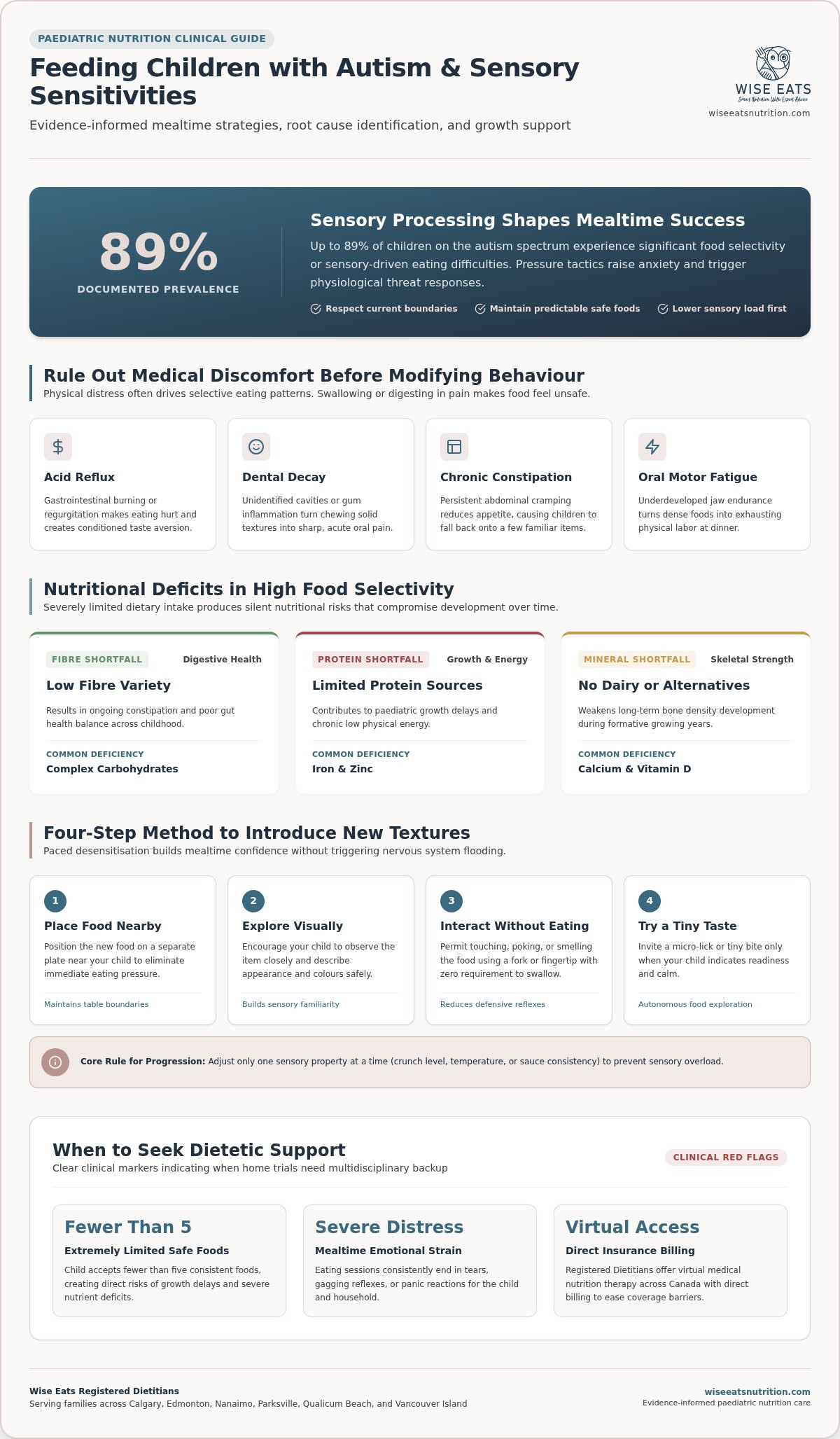
- Up to 89% of children with autism experience significant food selectivity or sensory-driven eating problems.
- Unless you rule out gastrointestinal pain, reflux, or dental decay first, behavioral feeding strategies often fail.
- Consult a registered dietitian if your child accepts fewer than five safe foods to prevent growth delays.
- Wise Eats provides virtual medical nutrition therapy across Canada with direct billing to simplify insurance coverage.
Feeding Kids with Autism and sensory disorders starts with matched mealtime support
Tailoring mealtime strategies to your child’s specific sensory issues helps create a peaceful eating environment. Forcing new foods often backfires and increases anxiety; gradual exposure builds comfort while respecting current boundaries.
Two or three patterns show up often, and each has a concrete next move drawn from the same playbook:
- Familiar-only eating (picky eating / food selectivity): keep preferred items on the plate and place small, non-pressured tastes beside them.
- Broader eating problems that affect growth or energy: bring in a registered dietitian so intake stays balanced while sensory limits are respected.
- Coverage uncertainty delaying care: confirm insurance direct billing so personalized support is easier to start.
Custom meal planning gives you a structured way to introduce variety without raising stress. Registered dietitians at Wise Eats focus on supportive habits rather than strict rules, so family mealtimes can become safer spaces for exploration.
Why autistic kids face feeding challenges
Autistic children experience picky eating because sensory, medical, and behavioral factors stack together at the table.
Here is one full arc many families recognize. Problem: your child gagged at dinner as texture, smell, or appearance set off sensory processing (sensory issues) like a loud siren in the body. Action: you lower the sensory load first, keep predictable safe foods available, and check whether pain or motor effort is also in play instead of pushing volume. Outcome: mealtime stops being pure threat, which is the base you need before variety can grow. Neurodivergent traits shape daily living activities, including how a youth accepts dinner, so pressure alone rarely solves food selectivity.
Feeding issues (eating problems) also come from physical discomfort. Gastrointestinal pain or reflux makes eating hurt and teaches fear. Muscle motor challenges can turn chewing into exhausting work. You can browse free meal plan resources for comfortable, nutrient-dense options that fit those limits.
Routine matters as much as sensation. Change feels unsafe, so autistic youth often stay with predictable items. Mapping the root cause before you escalate demands keeps trust intact.
Check medical issues before you change behaviour
Physical discomfort often drives severe eating problems in autistic children. Gastrointestinal pain, reflux, or dental decay can make swallowing painful, so those checks come before behavioural plans.
Chronic constipation is easy to miss and often shows up as extreme picky eating. When abdominal pain persists, safe familiar foods become the only comfortable choice.
According to the WHO autism Q&A, autistic individuals require accessible health services for general healthcare needs just like anyone else. Treating undetected reflux or oral pain often improves comfort at family meals and gives sensory processing work a fair chance.
Ask your medical team to rule out organic causes first. Practical food relationship guidance can then help you build safer, lower-stress habits. Physical comfort is what makes nutrition counseling feel trustworthy.
How restricted diets can harm long-term health
Severe food selectivity (picky eating) can create nutrient gaps that quietly affect your child’s long-term health and development. A very short list of accepted foods often leaves hidden shortfalls in vitamins and minerals because variety never gets a chance to supply them.
| Nutritional Risk | Health Impact | Common Deficiency |
|---|---|---|
| Low Fiber Variety | Constipation and poor gut health | Complex Carbohydrates |
| Limited Protein Sources | Growth delays and low energy | Iron and Zinc |
| No Dairy or Alternatives | Weakened bone density development | Calcium and Vitamin D |
Restricted feeding issues can hold for a while and then falter under daily stress. Longer-term risks include impaired bone density, compromised immunity, and chronic fatigue. Extreme sensory processing can also turn mealtimes into intense emotional strain for the whole household. Dietitian support is one route to widen the diet without stacking on more pressure.
Gradual steps that safely introduce one new texture
Introducing one new texture at a time helps children with sensory processing build confidence at meals without flooding their system.
- Place the food nearby: Keep the item on a separate plate to reduce pressure.
- Explore visually: Encourage your child to look at the texture and describe it safely.
- Interact without eating: Allow touching or smelling the food using a fork or finger.
- Try a tiny taste: Prompt a small lick or bite when they feel comfortable.
Picky eating eases when your child feels safe; small steps beat big leaps. Keep anxiety lower by changing only one sensory property per trial.
Tip: Always change only one sensory property at a time, such as crunch or temperature, to keep anxiety low.
When home strategies are not enough for ASD
Professional support is needed when severe eating problems compromise growth, energy, or overall health. Sensory issues can make mealtime overwhelming for autistic children, and early multidisciplinary care helps you avoid deep nutritional deficits.
Begin by reading stress around food. Long mealtime battles often point to physical or sensory discomfort still in the background. Ongoing stress can raise a child’s sensory threshold, so personalized nutrition counseling gives the family a safer way to handle daily hurdles.
If picky eating limits the diet to fewer than five safe foods, consult a registered dietitian. Across Canada, Wise Eats Registered Dietitians provide compassionate medical nutrition therapy tailored to that threshold. Reach out when you want a clear read on whether home strategies still match your child’s needs.
Choose the right therapist and navigate C$ costs
A good match for eating problems rests on credentials, clinical experience, and a care approach that fits sensory-driven refusal.
Look specifically for pediatric sensory processing background. Standard pediatric training does not always cover sensory-driven food refusal, so an occupational therapist or registered dietitian trained in responsive feeding therapy is the safer filter and prevents avoidable stress for your child.
In Canada, costs usually blend provincial health coverage, private insurance, and employee benefits. Occupational therapy is often partly covered by extended health plans; public clinics may be free with longer waits. Fees shift with location, specialization, and session length. Direct billing can cut immediate out-of-pocket cost.
Wise Eats Registered Dietitians offer custom meal planning and nutrition counseling shaped around sensory preferences. Ask clinics for a personalized quote so you can map session length and specialization against your budget before you commit.
Budget C$ therapy costs and insurance in Canada
Total cost for pediatric sensory processing care comes down to how you combine public funding and private insurance in Canada. Routes differ by province and by your benefits provider.
Families who pair private health plans with provincial disability grants often reduce out-of-pocket fees by a wide margin. Professional nutrition counseling then targets dietary gaps without scattering effort, and early planning limits surprise bills.
Private extended health benefits frequently cover a registered dietitian under medical nutrition therapy allowances. Provincial child disability benefits can trim program costs further, though each provider sets its own reimbursement thresholds.
Public funding fits families who need basic coverage; private plans fit families who need faster access. Compare both against your timeline, then request figures from providers so your monthly out-of-pocket amount is clear before care starts.
Details and enquiries: Wise Eats Registered Dietitians.
Frequently asked questions
What is the prevalence of ASD?
Autism Spectrum Disorder (ASD) affects about 1 in 50 Canadian children and youth according to the Public Health Agency of Canada. That rate is one reason specialized family supports matter nationwide.
How common is food selectivity in children with ASD?
Up to 89% of youth with autism experience picky eating or other feeding issues. Those patterns can sharply limit the foods a child will accept day to day.
What sensory factors contribute to food selectivity?
Hyper-reactivity to sensory input often causes intense distress around specific textures, strong smells, bright colours, or temperatures. Children with sensory processing differences may drop whole food groups to avoid uncomfortable oral sensations.
Do children with ASD have poorer nutritional adequacy?
Children with ASD frequently take in less calcium and vitamin D when diets stay restricted. A registered dietitian can help you raise nutrient intake while still honouring sensory boundaries.
What medical issues should be checked first?
Gastrointestinal discomfort, reflux, and dental pain should be evaluated first by medical professionals. Once physical pain is ruled out, personalized nutrition counseling can support the family around food without fighting an untreated cause.
Next steps that protect mealtime peace
The same decision line you met at the start still holds: when picky eating or sensory issues threaten growth, energy, or keep the diet under five safe foods, steady professional care is the path that protects both nutrition and mealtime peace.
Wise Eats Registered Dietitians provide virtual medical nutrition therapy across Canada, with a focus on gentle habits for complex feeding issues. Tailored guidance can widen accepted foods while you guard the calm at the table. Book a discovery call when you want Feeding Kids with Autism and sensory disorders support matched to your household.

Article by
Rachel McBryan, Dietitian
Rachel McBryan is a licenced Dietitian in British Columbia offering comprehensive nutrition counselling as virtual and/or in-person counselling sessions to suit your needs and preferences. With a Bachelor of Science in Nutrition and Food Science, Rachel has over 20 years experience helping people address their health through nutrition. She was awarded Human Nutrition and Food Science BSc.from University of Alberta followed by post-grad course work at UBC in guidance counselling.
An eating disorder is a serious mental health illness.
If you are in immediate distress or crisis, please contact emergency services by dialing 911 or calling Vancouver Island Crisis Line: 1-888-494-3888.