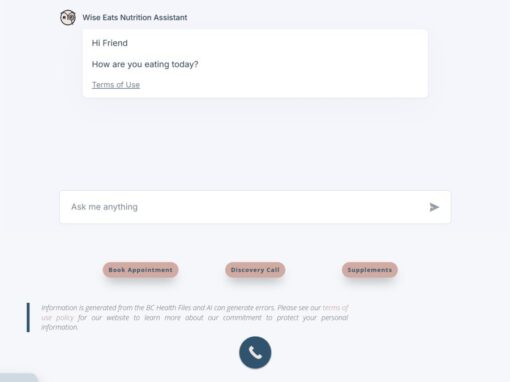
A confident answer isn’t always a reliable one. The dietitian vs LLM for nutrition advice question often starts with a quick search for meal ideas, supplement information, or help with a health concern. Large language models can sound certain, even when an answer misses important context or contains errors.
It makes sense to want clear guidance without sorting through conflicting advice. LLMs generate responses by predicting likely next words, so fluent wording doesn’t confirm accuracy. They don’t know your health history, food preferences, or daily routine unless you share them. Even with those details, they don’t assess your needs as a Registered Dietitian does.
This article explains which nutrition questions suit AI for general learning, the limits of its advice, and when personal or health concerns call for professional support. You’ll learn how a Registered Dietitian considers your goals and daily routines, plus find a practical next step for nutrition care in Alberta or British Columbia.
Key Takeaways
- Use an LLM for general definitions, meal ideas, or questions to discuss with your healthcare team, not as a substitute for personal nutrition support.
- The dietitian vs LLM for nutrition advice comparison helps you weigh general information against guidance shaped by your health context and daily routines.
- Before acting on an AI response, check its sources, look for uncertainty, and note questions for your care team.
- A 2025 study in Scientific Reports offers research context on LLM nutrition advice and why response quality deserves careful review.
- A Registered Dietitian considers your goals, food preferences, eating patterns, and relevant health context. Wise Eats Registered Dietitians offers sessions in Alberta and British Columbia.
Dietitian vs. LLM for Nutrition Advice: What Is Each One?
A nutrition answer can arrive in seconds and sound clear, yet still miss details about your health, food preferences, or daily routine. The gap matters when you’re deciding what to eat, considering a supplement, or sorting through conflicting guidance. The dietitian vs LLM for nutrition advice comparison comes down to the help you need: a general explanation or support shaped around your circumstances.
A large language model (LLM) is software which generates text using patterns in its training and the information in your prompt. A Registered Dietitian is a regulated nutrition professional with formal education and professional judgment to guide conversations about food and health.
For a brief introduction to the dietitian profession, see What is a Dietitian?. This video offers another perspective on evidence-based practice:
What an LLM does when you ask a nutrition question
An LLM responds to a prompt by predicting a sequence of words which fits patterns in its training data and your input. Ask for a plain-language explanation of fibre, for example, and it might provide a useful overview. Request meal ideas, and it might suggest options based on the details you share.
Natural-sounding wording doesn’t confirm accuracy. An answer might leave out an important detail, present uncertain information as settled, or miss health conditions and other personal factors. An LLM provides general information. It doesn’t conduct a nutrition assessment or offer individualized nutrition care.
What a Registered Dietitian brings to nutrition advice
In Canada, a Registered Dietitian is a nutrition professional with accredited education, supervised practice, and a licensing exam, regulated by a provincial college. The protected title signals specific training and professional accountability. A dietitian is a person you speak with, not a chatbot or search engine.
In collaborative nutrition counselling, a dietitian asks about your goals, eating patterns, preferences, and relevant health context. They connect evidence-informed information with your needs, then discuss practical options for daily life. Learn more about working with a Registered Dietitian and personalized nutrition support.
Use an LLM to get oriented or prepare questions. For advice tied to your personal health needs, a Registered Dietitian offers a tailored conversation and works alongside your healthcare team.
How LLM Nutrition Advice Works, and Why Its Quality Varies
An LLM’s response shifts with the wording and detail in your prompt. “Suggest lunches” offers little context. Add ingredients you have, food preferences, or time available, and the suggestions might better reflect your request. Extra details shape the response, but they don’t verify nutrition claims or turn general information into care tailored to your health.
Why the same nutrition question might get different answers
Ask “What should I eat for more energy?” and you might receive broad meal ideas. Add a budget, schedule, or food preference, and the answer will reflect those details. Your prompt influences the result, but the model might miss important context you didn’t include or fail to flag uncertainty.
Model versions and question topics also affect results. A 2025 study in Scientific Reports examined LLM performance on Registered Dietitian exam questions. Its findings describe differences in accuracy and consistency across prompts and question areas. Exam performance offers one way to assess responses, but it doesn’t show how well a chatbot accounts for an individual’s daily needs. Research on LLM performance is still developing, and results depend on the task.
Polished wording is not verified nutrition guidance. Check the source behind a health claim, especially before acting on advice tied to a health concern.
What a chatbot cannot learn from a short prompt
A chatbot responds to the details available in the conversation and information its system accesses. It won’t know your health history, medications, food access, cultural food practices, or care-team guidance unless you provide relevant details. Even with more information, it doesn’t assess whether your account is complete or follow up with the judgment of a nutrition professional.
Two people requesting a meal idea might have different needs because of allergies, digestive symptoms, a health condition, or food available at home. A short prompt might leave out these factors. Think carefully before sharing sensitive health details with an online tool.
A chatbot conversation doesn’t create an ongoing professional relationship. No person checks how a suggestion fits, hears what didn’t work, or revisits the advice as your needs change. The Academy of Nutrition and Dietetics outlines Registered Dietitian Nutritionist qualifications, including education and professional training.
For nutrition questions shaped by your health or daily routine, bring your concerns to a dietitian and discuss practical next steps.
Dietitian vs. LLM: Compare the Advice Before You Act
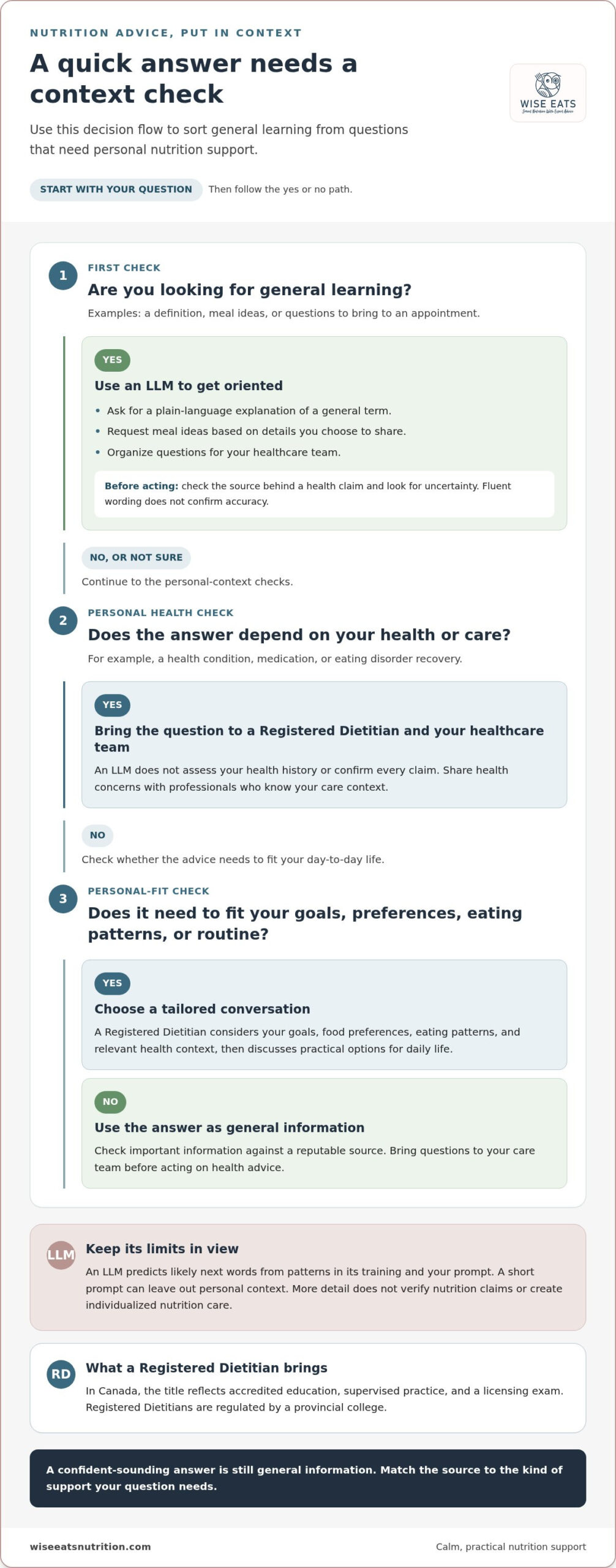
Use an AI answer to get oriented, then decide whether the question needs personal support. The right choice depends on what you plan to do with the information. A definition or a list of meal ideas is different from advice tied to a health condition, medication, or eating disorder recovery.
| Source | Suitable uses | Limits | Next step |
|---|---|---|---|
| LLM | Explain a general term, suggest meal ideas, or organize questions for an appointment. | Doesn’t assess your health history or confirm every claim. | Check important information against a reputable source, then bring questions to your care team. |
| Registered Dietitian | Discuss nutrition needs in relation to your goals, preferences, health context, and routine. | Doesn’t replace your broader healthcare team or diagnose medical conditions. | Share relevant context and work together on practical nutrition support. |
When AI nutrition answers are useful for general learning
For a low-risk question, an LLM might explain what “whole grains” means or suggest ways to organize a grocery list around ingredients you already have. You might also ask it to turn a concern into questions for an appointment. Treat the response as a starting point for further reading, not a personal care plan.
Check health claims against trusted Canadian public-health sources, such as Health Canada’s food and nutrition resources. If an answer makes a specific claim about a supplement or health condition, look for the original source rather than relying on a confident summary. Put conflicting or unclear information on your list of questions instead of following it without support.
When personal context matters more than a general answer
Nutrition discussions involving diabetes, digestive concerns, supplements, or eating disorder recovery need careful attention to personal circumstances. For example, a general meal suggestion doesn’t account for your care-team guidance or the details of your health history. A dietitian-led discussion connects nutrition information with what you’ve shared and supports coordination with your existing care team as appropriate.
For condition-related nutrition support, a Registered Dietitian discusses Medical Nutrition Therapy and nutrition counselling in the context of your needs. This support complements care from other health professionals. Don’t change medication or set aside existing medical advice based on a chatbot response.
The dietitian vs LLM for nutrition advice choice becomes clearer when you ask whether the answer needs to account for your personal health and daily life. AI can help you prepare. For ongoing questions about nutrition misinformation, including advice shared on Reddit, check the source and discuss concerns with your care team.
How to Check AI Nutrition Advice and Know When to Seek Help
If an AI response leaves you unsure what to trust, pause before acting on it. In the dietitian vs LLM for nutrition advice decision, the stakes and personal details behind your question matter. Use this short check to decide whether an answer is useful background or a reason to speak with your care team.
A practical check for an AI-generated nutrition answer
- Identify the question. Is it a general request, such as defining a nutrition term, or does it involve your health, symptoms, medication, or supplement routine?
- Check the source. Look for named, current sources you can read yourself. For Canadian guidance, start with reputable public-health sources such as Health Canada. If the response gives no sources, treat specific health claims with care.
- Note uncertainty. Be cautious of absolute promises, strong claims without evidence, or advice which conflicts with guidance from your healthcare team. A confident tone doesn’t settle a disagreement.
- Choose your next step. Keep useful questions for an appointment. Don’t change medication or set aside existing medical advice based on an AI response.
You don’t need to verify every general suggestion before using it as a starting point for further reading. If you plan to act on advice tied to a health concern, discuss it with a qualified health professional. An AI answer might leave out a detail you didn’t know to include or present uncertain information as settled.
Bring the response, or a brief summary of it, to your healthcare team. You might say, “I received this advice about a supplement. Does it fit with my health history and current care?” This gives your team a clear question to address and keeps the conversation connected to the advice and care you already receive.
When to Seek Help with nutrition advice
It’s okay to ask for support if eating or nutrition advice feels difficult to manage. Consider speaking with a healthcare professional or your care team if you notice any of these concerns:
- You’re avoiding more foods over time or feel strong fear or distress around eating.
- You’re experiencing binge eating, or using behaviours such as vomiting or excessive exercise to compensate for eating.
- You have concerning physical symptoms, or eating concerns are leading you to withdraw from social activities or spend less time with people.
These signs don’t point to one cause on their own, and you don’t need to work it out by yourself. A healthcare professional can help you decide on a suitable next step. If binge eating is part of your concern, a dietitian offers nutrition support alongside the rest of your care team. Read about eating disorder recovery nutrition support.
How WISE EATS Nutrition Dietitians Support Personalized Advice
A useful nutrition plan needs to fit the person following it. A Registered Dietitian considers your goals, eating patterns, food preferences, health context, and everyday routines before discussing practical options. This personal conversation is a key difference in the dietitian vs LLM for nutrition advice comparison: an LLM responds to the details in a prompt, while a dietitian asks questions and adapts support through discussion.
What personalized nutrition counselling involves
Wise Eats Registered Dietitians offer collaborative nutrition counselling. You can share what you hope to work on, what feels manageable, and any concerns about food or health. A dietitian provides evidence-informed nutrition education and support without diagnosing medical conditions or replacing your healthcare team. Learn more about working with a Registered Dietitian and the counselling process.
Support includes Medical Nutrition Therapy, meal planning, digestive health nutrition, or eating disorder recovery, depending on your needs. For example, a meal plan should reflect your preferences and routine rather than rely on a generic template. If a concern involves a medical condition, your dietitian provides nutrition support in coordination with your existing care team.
The team includes Rachel McBryan, RD, College of Health and Care Professionals of BC, and Sheirry Poposka, RD, Alberta College of Dietitians. They bring professional nutrition knowledge to a conversation focused on your goals and circumstances.
Online Registered Dietitian support in Alberta and British Columbia
Wise Eats Registered Dietitians offer online, in-person, and home-visit nutrition sessions in their service areas. Online services are available across Alberta and British Columbia, including Calgary and Edmonton, Nanaimo, Parksville, Qualicum Beach, and other Vancouver Island communities. Online sessions give you a way to discuss nutrition questions from home.
You might bring notes from an AI conversation, questions about a supplement, or a meal-planning challenge. Your dietitian helps you sort through the information, consider what fits your situation, and identify questions for your other health professionals. You remain part of the decision-making process, and the discussion focuses on practical support rather than rigid rules.
If you’re ready to talk through nutrition questions with a Registered Dietitian, connect with a dietitian.
Choose Support That Fits Your Next Step
Let your next nutrition step reflect the kind of support you need today. The dietitian vs LLM for nutrition advice question offers a useful pause: what would help you feel informed and supported? You don’t need to have everything figured out before asking for help.
Start with one concern you’d like to discuss. It might be a nutrition goal, a change in your routine, or uncertainty about advice you’ve received. Sharing what matters to you gives a dietitian a place to begin and keeps the conversation focused on a balanced, flexible approach to eating and your nutritional needs.
Support should respect your preferences and fit into your life. A Registered Dietitian works with you and your healthcare team as you consider practical options. If a conversation feels like the right next step, book an appointment.
Speaking with a registered dietitian can help you develop a balanced, flexible approach to eating and meet your nutritional needs.
Frequently Asked Questions
Is AI reliable for nutrition advice?
AI is useful for general nutrition learning, but check an answer before treating it as reliable personal advice. An LLM response sometimes omits safety details or offers claims without strong sources. It might explain a nutrition term or suggest lunch ideas, yet still miss factors relevant to your health. Check important claims against current Canadian public-health information, and bring questions about symptoms, conditions, medications, or supplements to your healthcare team.
How does a Registered Dietitian differ from an LLM for nutrition support?
A Registered Dietitian discusses nutrition with you and considers how your goals, health needs, food preferences, and routine fit together. An LLM generates a response from the prompt you enter. If you ask about a supplement, for example, a dietitian discusses your health context and questions for your care team. The dietitian vs LLM for nutrition advice distinction is about personalized professional support versus information generated from a prompt.
What happens if an AI nutrition answer conflicts with advice from my healthcare team?
Don’t follow the AI response in place of guidance from your healthcare team. Save the answer and its sources, then ask your doctor, pharmacist, or dietitian to explain the difference. You might say, “This chatbot suggested a change to my eating routine. How does it fit with the advice I already received?” Don’t stop or change medication based on an AI response.
Can I use an LLM to create questions for a dietitian appointment?
Yes. Ask it to help organize your concerns or suggest questions for your appointment. For instance, try: “Help me list questions about meal planning with my work schedule and food preferences.” Review the list, remove anything which doesn’t sound like you, and add details you want to discuss. Treat the result as a draft, not an assessment or nutrition plan.
Is a Registered Dietitian title regulated in Canada?
Yes. Registered Dietitian is a legally protected title in Canada, regulated by provincial colleges. Dietitians complete accredited education, supervised practical training, and a registration exam. Provincial regulators set professional standards and oversee accountability. To check a dietitian’s registration, look to the regulatory college in the province where they practise. This helps distinguish a regulated professional title from general nutrition advice online.
How do I find online nutrition counselling in Alberta or British Columbia?
Wise Eats Registered Dietitians offer online nutrition counselling for clients in Alberta and British Columbia, including Calgary and Edmonton, Nanaimo, Parksville, Qualicum Beach, and other Vancouver Island communities. Online appointments give you a way to discuss nutrition questions from home. To arrange a session with a Registered Dietitian, visit the appointment booking page.
Article by
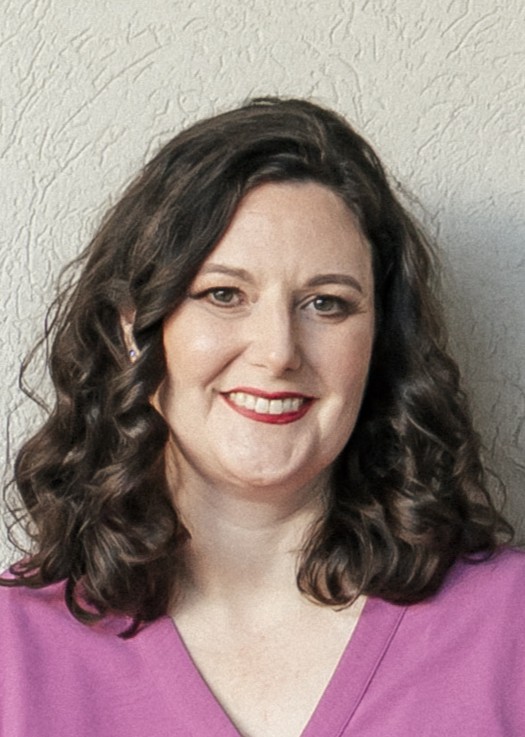
Rachel McBryan, Dietitian
Rachel McBryan is a licenced Dietitian in British Columbia offering comprehensive nutrition counselling as virtual and/or in-person counselling sessions to suit your needs and preferences. With a Bachelor of Science in Nutrition and Food Science, Rachel has over 20 years experience helping people address their health through nutrition. She was awarded Human Nutrition and Food Science BSc.from University of Alberta followed by post-grad course work at UBC in guidance counselling.
An eating disorder is a serious mental health illness.
If you are in immediate distress or crisis, please contact emergency services by dialing 911 or calling Vancouver Island Crisis Line: 1-888-494-3888.